

Managing Syria’s Forests Amid Environmental and Social Challenges
- Issue 14
Deforestation in Syria is no longer a background issue. Years of pressure on land, fuel, and livelihoods have turned a manageable problem into a structural one that is reshaping the country’s ecology, climate, and economy—and, increasingly, its stability.
Global Forest Watch data show that Syria lost 30,000 hectares (about 74,000 acres) of tree cover between 2001 and 2024, equivalent to 29 percent of its 2000 tree cover, with the steepest losses in the coastal and western mountain ranges. Between 2010 and 2019, one study found that Syria has lost nearly 20 percent of its forest cover, primarily in the northwestern part of the country. Another study broke this down further: in Latakia governorate forest cover has fallen by roughly 30–35 percent; in Hama about 25–30 percent; and in Idlib close to one-quarter.
These forests once served as a natural shield against drought, erosion, and landslides. Their loss now exposes fragile terrain to heat, flash floods, and hunger—consequences compounded by a warming climate and faltering governance. How and whether the government is able to respond could also increase tensions given the heterogeneous nature of the most affected areas and years of conflict between communities.
Forests and the Economy of Survival
For more than a decade, deforestation has been driven as much by necessity as by neglect. With fuel and electricity unreliable or prohibitively expensive as noted in the previous section, wood became the fallback energy source. Families cut trees to heat their homes, while traders turned the practice into a market. What began as a coping strategy hardened into an informal economy linking households, transporters, and armed groups. And the situation may worsen in the coming months: the government has increased electricity prices nearly sixty-fold, with monthly bills rising between 200 and 300 percent by some accounts.
Wood-cutting now functions as one of the few dependable incomes in parts of the countryside. Truckloads of timber move daily from forested slopes to towns. The charcoal trade connects cutters, processors, and urban merchants—a largely unregulated supply chain that has become part of daily survival. Charcoal from the coast moves inland, traded for food, fuel, and construction materials. Forests that once supported farming now feed black markets that strip the same land of its future use, since fruit and olive trees are not immune to the practice.
A 2023 PAX for Peace found that western Syria lost more than one-third of its wooded area between 2018 and 2020 because of unchecked cutting and repeated fires. In northern Aleppo, armed groups were primarily responsible for unregulated logging that reduced local tree cover by nearly 60 percent.
A Year of Fire
Though the 2020 fires were the worst ever recorded in Syria’s history, consuming tens of thousands of hectares across multiple provinces, the summer of 2025 was also destructive, destroying around 14,000 hectares of forest—an area larger than Paris.
To illustrate this, we produced an interactive tool that shows how Syria’s land cover has changed over time. It lets users pick any region and explore monthly or yearly changes across nine categories—such as water, trees, crops, and built-up areas—using a simple, color-coded map.
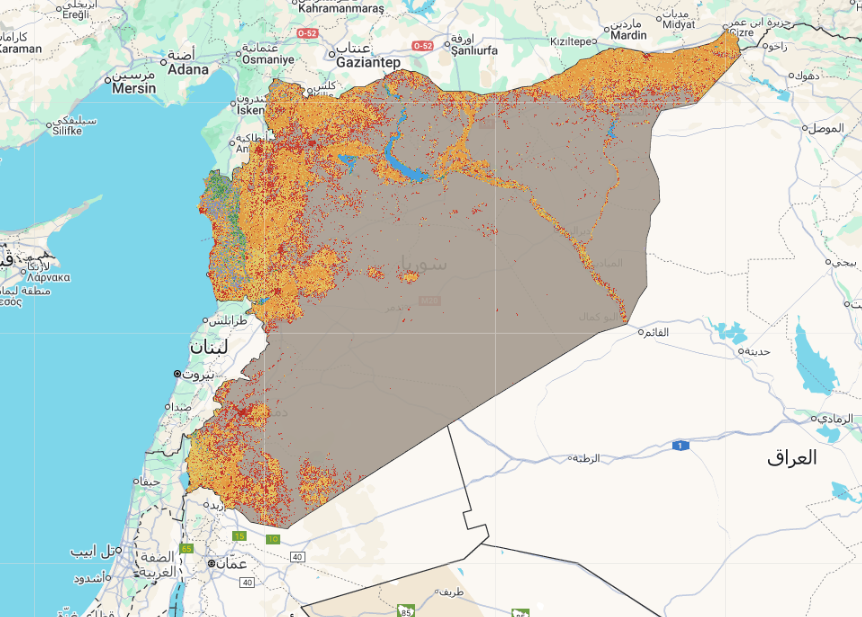
Fires are no longer isolated events. They sweep rapidly through dry brush, abandoned orchards, and steep slopes, often reaching farmland before containment crews arrive. Many of these areas had already been weakened by illegal logging and years of drought, leaving them highly flammable. Civil-defense teams face rugged terrain, poor access roads, and chronic shortages of equipment. Farmers often join the effort with shovels and buckets, sometimes in mine-contaminated zones. Those mines and unexploded ordnance both create fires and are set off by them—an increasingly deadly symbiotic relationship.
The Climate Connection
Syria has experienced increasingly frequent and longer droughts, with climate change making them more likely and more severe. One study found that a recent three-year drought was 25 times more likely because of climate change. Rainfall has become more erratic, shortening growing seasons and leaving forests tinder-dry by mid-summer. According to a representative of the UN Food and Agriculture Organization (FAO) in Syria, 2025 was one of the worst droughts in sixty years.
Climate change amplifies the effects of deforestation: fewer trees mean less shade and moisture, drying the soil faster and fueling the next fire. The result is a vicious cycle where heat, drought, and land degradation drive one another, converting once-resilient slopes into barren, fire-prone ground within a decade.
Agricultural Consequences
Deforestation has intensified the strain on Syria’s agricultural base. Forests anchor soil, regulate water, and protect farmland from erosion. Without them, land dries quickly in summer and floods after heavy rain.
At the national level, Syria’s olive oil production for the 2023/2024 season is estimated at 95,000 tonnes (≈105,000 US tons)—a 24 percent decrease from the 125,000 tonnes produced in 2022/2023—and the problem has accelerated in certain areas. In Hama’s Sahl al-Ghab, fires cut local olive oil output by more than half. In Daraa governorate, the number of olive trees has fallen from six million before 2011 to about three million in 2023, and cultivated area has shrunk from 30,000 to 22,900 hectares.
Reports from rural Quneitra and western Daraa suggest that Israeli military expansion along occupied border zones has led to the clearing of olive groves and forested land for new outposts and patrol routes. In October 2025, field observations, satellite reporting, and regional coverage documented large-scale bulldozing in the Jubbata al-Khashab reserve near Quneitra, where centuries-old trees were cleared to make way for military infrastructure. A satellite time-lapse from 24 May to 26 October 2025 for Hersh Al Shahhar near Jubbata al-Khashab shows that the bulldozing intensified in June. Comparing imagery from 3 June and 26 October 2025 highlights the extent of tree cover removed during this period. A parallel comparison for the Jubbata al-Khashab reserve shows a smaller but still increasing rate of clearing in October 2025. Farmers report that access to nearby groves has been restricted since mid-year, increasing pressure on southern communities already facing environmental decline.
Further north, along the Euphrates and across the semi-arid plains of Deir Ezzor, desertification is advancing as river levels drop and wells run dry. Trees that once lined the riverbanks have been cut for fuel or cultivation, leaving soil exposed to wind and erosion. Satellite imagery shows widespread degradation across Deir Ezzor and Raqqa. Many farms are now abandoned, and wells no longer refill.
Replanting and Local Response
Despite the scale of loss, some small-scale recovery efforts are underway. Around Maydanki Lake near Afrin, volunteers launched a campaign in October 2025 to plant 20,000 trees on stripped hills around the reservoir. Supported by local councils and community groups, the project (“عفرين تستاهل / Afrin Deserves It”) is a civic-led restoration initiative. The Ministry of Agriculture has also announced plans to replant 5,000 hectares in Latakia, Tartous and Hama during the 2025–26 season—the equivalent of more than one-third of the area burned this year. Progress remains slow due to funding shortfalls, recurring fires, and limited technical capacity. In Hama, local officials are preparing long-term rehabilitation for the burned slopes and orchards of Sahl al-Ghab, including replacing destroyed olive trees and restoring irrigation infrastructure, but acknowledge that available resources remain far below requirements.
Rising Tensions and the Politics of Neglect
As forests disappear, so too does confidence in the state’s ability to protect the land. The areas suffering the greatest deforestation and fire damage—Latakia, Hama, Idlib, and the Alawite mountain belt—are also zones of past and lingering conflict, divided among communities that were on opposite sides during Syria’s war.
The perception that the government responds slowly to wildfires or prioritizes certain areas over others risks deepening mistrust. In villages near Slenfeh and Jabal al-Turkman, residents have accused local officials of ignoring early warning signs or diverting firefighting equipment to “protected” state plantations while communal land burned.
Environmental stress is becoming a new axis of instability. Competition over shrinking wood, water, and arable land now intersects with long-standing divides between loyalist and displaced communities, particularly where the loss of forest access also means loss of livelihood. Without credible prevention measures and compensation plans, the sense of abandonment could harden into local unrest.
Toward Protection and Renewal
Reversing deforestation requires more than seasonal planting. Forest-protection laws must be enforced, affordable energy alternatives introduced to reduce dependence on wood, and local firefighting capacity expanded through access roads, aerial units, and early-warning systems. Reforestation efforts must also be climate-adapted, prioritizing drought-resistant native species, rain-harvesting, and community-managed firebreaks.
Deforestation has become not only an ecological crisis but also a test of governance. Environmental preservation and disaster-risk reduction are now inseparable from political recovery. If the state cannot protect the land, communities may view continued forest loss as further evidence of corruption and neglect. An effective response, however, could open a rare avenue for rebuilding trust between people and institutions—and among communities long divided by war.