
By: Mohamad Ahmad
The Syrian Petroleum Company (SPC) revealed at the Syrpetro 2026 exhibition that Syria plans to expand its refining capacity threefold, from around 135,000 to approximately 410,000 barrels per day (bpd) in the “coming years.” The ambition is striking: the targeted refining base exceeds both Syria’s existing refining capacity and its domestic crude production, even before the conflict.
The planned increase rests on three projects. Baniyas, Syria’s current principal operating refinery, is reportedly undergoing rehabilitation to restore its nominal capacity of 130,000 bpd. SPC has also tendered the establishment of a new 210,000 bpd refinery at Furqlus, near Homs. Designed to process a mix of light and heavy crude, the facility is expected to be completed within 40 months. Of note, the Furqlus tender explicitly allows potential investors “to blend Syrian crude with other imported crudes in case Syrian crude is unavailable.” It is also intended to replace the aging Homs refinery.
Another new refinery, with a 70,000 bpd capacity, is planned for Deir Ezzor, adding downstream capacity closer to Syria’s oil fields. The project is expected to be executed ahead of the Furqlus refinery.
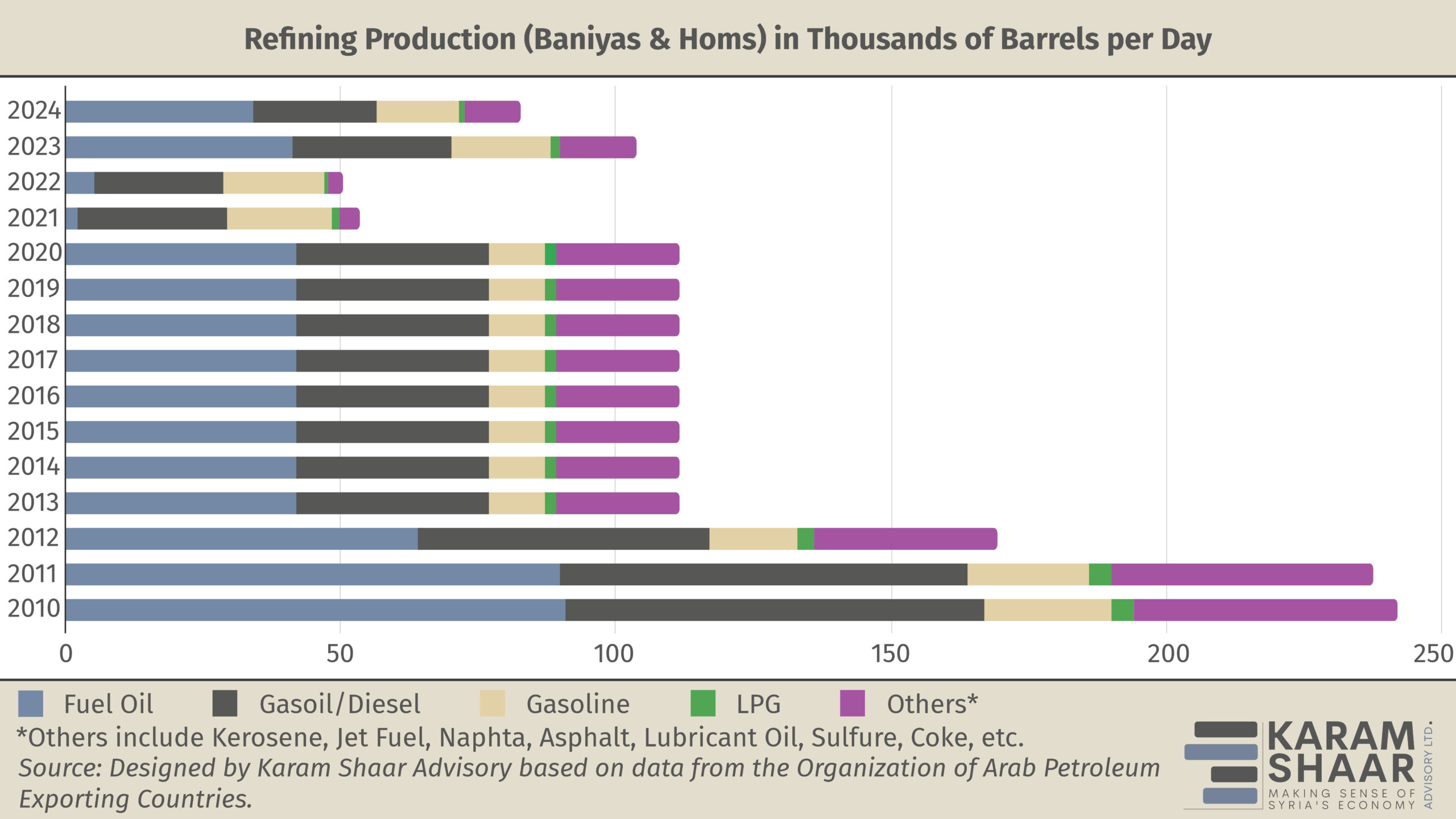
Before the conflict, Syria’s two refineries processed approximately 240,000 bpd combined. By 2022, this fell to roughly 50,000 bpd, as aging equipment, damaged infrastructure, limited feedstock, and maintenance backlogs constrained operations. Subsequent improvements increased operational refining capacity to almost 83,000 bpd in 2024 and to over 100,000 bpd by 2026.
Currently, the Baniyas and Homs refineries produce approximately 90,000 and 45,000 bpd, respectively. Additional refining capacity will also help ease the country’s persistent fuel product shortages.
Yet the domestic market remains exposed to dependence on crude imports, as well as disruptions in procurement, logistics and distribution. Addressing these constraints will require parallel improvements in upstream production, crude and product storage, refinery reliability, and fuel-distribution capacity.
Ultimately, the viability of Syria’s refining ambitions will depend on both attracting investors and securing consistent crude supplies. Current domestic production of around 133,000 bpd would meet only about one-third of the targeted refining capacity. The tender’s explicit provision for bidders to blend Syrian crude with imported grades indicates that SPC recognizes the need to diversify supply and expand procurement capacity.