By: Vittorio Maresca di Serracapriola and Omar Albeik
Contents
1. Sanctions Termination Without Digital Reintegration
For more than a decade, sanctions on Syria restricted not only trade and financial transactions but also access to essential digital technologies. Software development platforms, cloud infrastructure, payment gateways, and online learning tools were either legally unavailable or withdrawn by companies seeking to avoid compliance risk. As a result, Syrians were largely excluded from the global digital economy, limiting opportunities for education, entrepreneurship, and remote work.
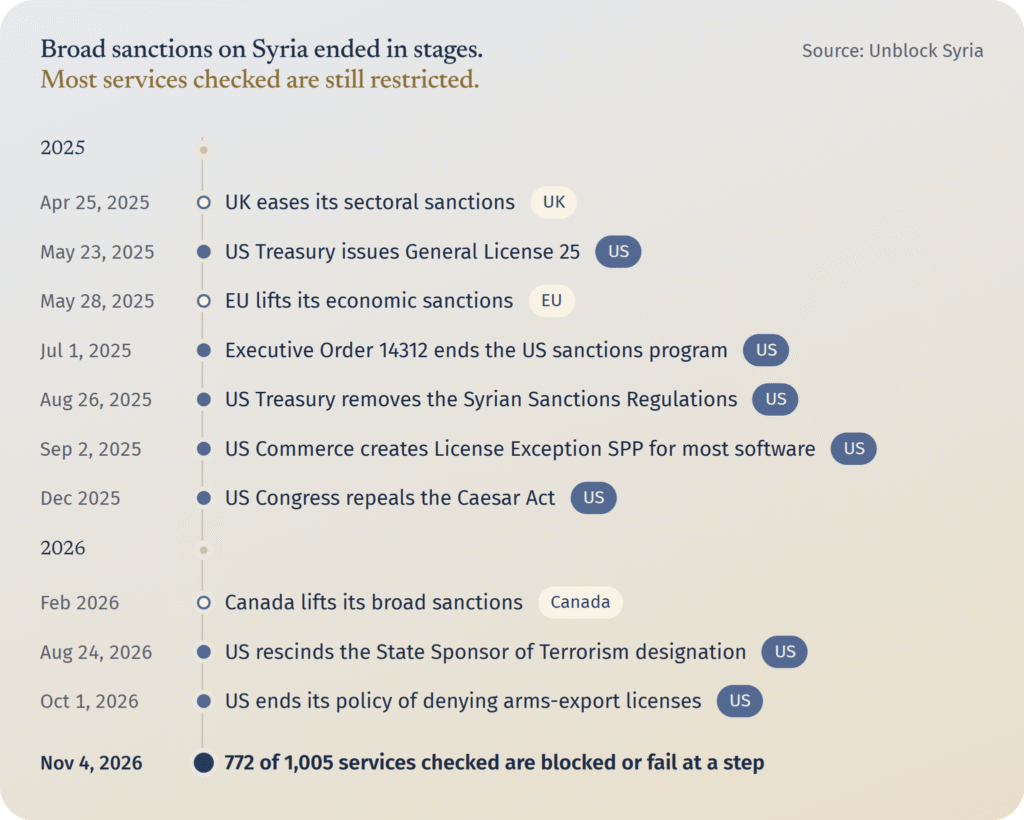
Since 2025, the legal landscape has changed fundamentally. On May 23, 2025, the US Treasury issued General License 25, which authorized almost all transactions previously prohibited by the Syrian Sanctions Regulations. Executive Order 14312, effective July 1, 2025, terminated the national emergency on which the US Syria sanctions program rested, and on August 26, 2025, the Treasury removed the Syrian Sanctions Regulations from the Code of Federal Regulations. On September 2, 2025, the Commerce Department relaxed export controls, creating License Exception Syria Peace and Prosperity (SPP), which allows items designated EAR99, including most ordinary commercial software, to be exported to Syria without an individual license. In December 2025, Congress repealed the Caesar Syria Civilian Protection Act through section 8369 of the FY2026 National Defense Authorization Act.
The last major US measure followed in 2026. On August 24, 2026, the Secretary of State rescinded Syria’s designation as a State Sponsor of Terrorism, which had been in place since 1979, and revoked the remaining terrorism listing of Hay’at Tahrir al-Sham (HTS) (91 FR 55965, 91 FR 55967). The Treasury then removed the Syria-specific general license from its terrorism-list regulations (91 FR 60825), and the State Department ended its policy of denying arms-export licenses for Syria on October 1, 2026 (91 FR 62313).
Other jurisdictions moved in parallel. The European Union lifted its economic sanctions in May 2025, the United Kingdom eased its sectoral restrictions in April 2025, and Canada repealed its broad sectoral sanctions in February 2026. Each kept narrower measures, mainly on people linked to the former regime, and the EU and UK also kept measures on the captagon trade.
What remains is narrow. Targeted US sanctions on Assad-era figures, captagon traffickers, and terrorist affiliates are still in force. Syria also remains in the Commerce Department’s most restrictive export-control group (Country Group E:1) until a new rule removes it, which means items on the Commerce Control List, including mass-market encryption software, still require a license or an applicable exception. Syria is also still on the Financial Action Task Force grey list. None of these measures requires a company to block a Syrian user from opening a website, creating an account, or subscribing to a hosted service.
In principle, Syrians should now be able to access the platforms previously unavailable to them, particularly in education and technology. Yet the legacy of earlier sanctions continues to shape access. For years, developers were unable to use repositories and cloud services, students could not download software required for online learning, and entrepreneurs lacked the payment infrastructure needed to participate in global markets. Even basic app distribution channels were restricted, limiting access to secure communication tools and exposing users to additional security risks.
2. Why Are There Still Obstacles to Digital Services in Syria?
Despite the lifting of comprehensive sanctions, access to digital services from within Syria remains heavily restricted in practice. Across sectors, including artificial intelligence tools, payment infrastructure, education platforms, developer environments, and cloud services, Syrian users continue to encounter barriers that prevent account creation, disable core functionality, or block access entirely.
The Unblock Syria initiative has emerged as the primary civil-society effort documenting and addressing these barriers. Since January 2026, the platform has combined community testing from inside Syria with structured company outreach and technical verification of access conditions.
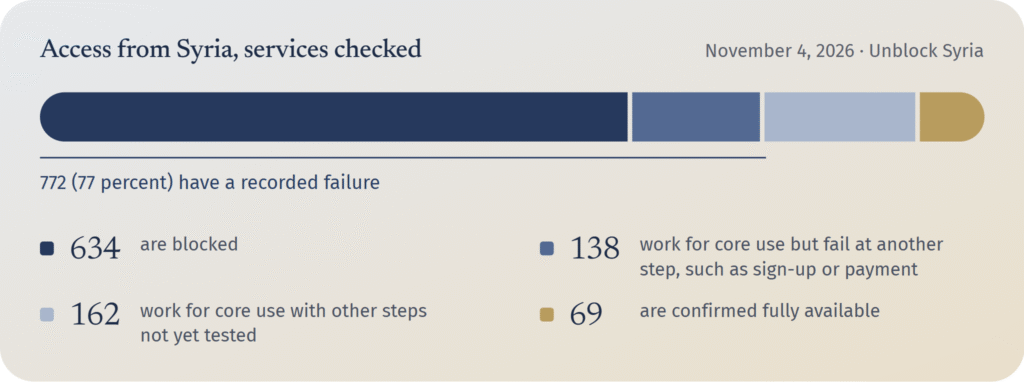
Data collected by the initiative provides the most detailed snapshot currently available. As of November 4, 2026, the platform tracks 1,236 international digital services that people in Syria need. Of the 1,005 that have been checked for access from Syria, 634 are blocked and 138 more work for core use but fail at another step, such as sign-up or payment. In total, 772 of the 1,005 checked services (77 percent) have a recorded failure more than a year after the US sanctions program ended. A further 162 work for core use with other steps not yet tested, and 69 are confirmed fully available. Because services enter the register when users report needing them, these figures describe the services Syrians actually rely on rather than a random sample of the internet.
Persistent Restrictions Across Core Digital Platforms
Restrictions affect precisely the platforms most central to participation in the global digital economy. Among the services that remain blocked from Syria are:
- AI assistants such as ChatGPT and Claude
- Collaboration tools such as Slack
- Online education platforms including Coursera and Udemy
- Payment infrastructure such as PayPal and Stripe
- Cloud services including most Amazon Web Services products tested, such as Amazon CloudFront
- Creative and design software such as Figma
- Social media and streaming platforms such as TikTok, Netflix, and Spotify
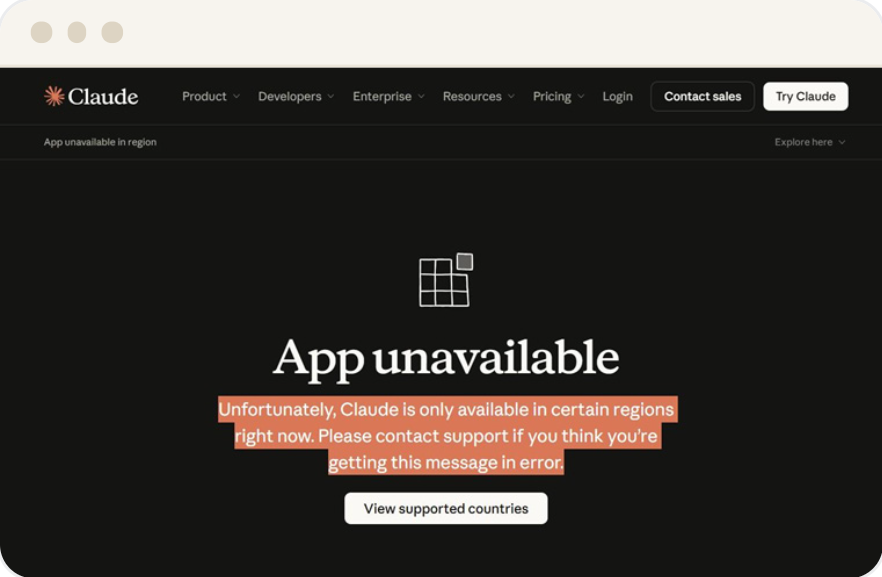
Access to Claude from Syria, October 27, 2026
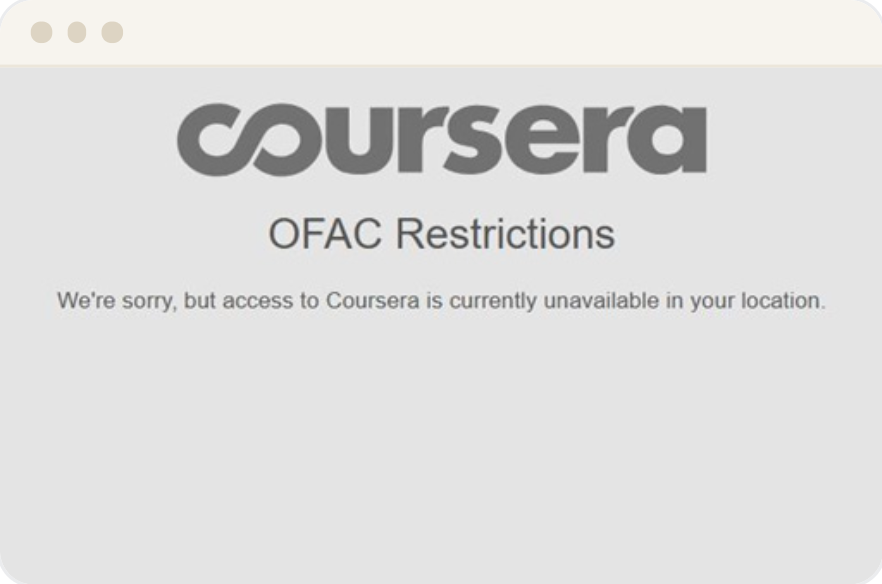
Coursera’s “OFAC Restrictions” page from Syria, October 8, 2026.
These restrictions often operate at several layers at once: website geo-blocking, disabled sign-up flows, rejected Syrian phone numbers, failed identity verification, and payment refusals. Where each step has a recorded result, the landing page fails for 397 of 1,005 services. Even among services whose core use works from Syria, payment fails for 85 of 92.
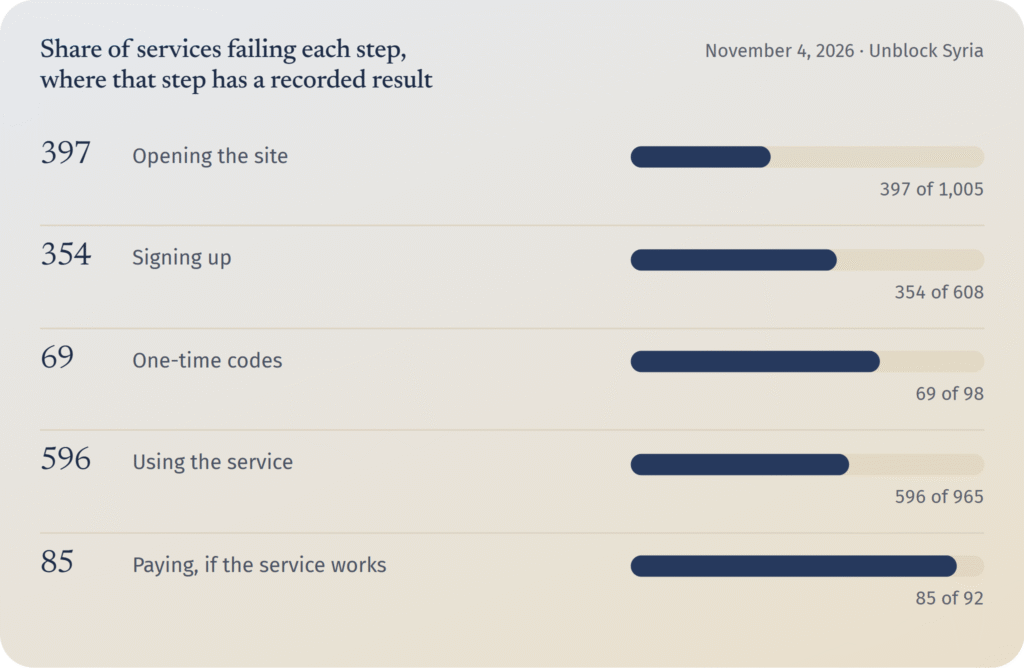
Payment processors sit at the center of this pattern. Stripe’s financial crimes policy, dated November 2023 and still published, lists Syria among the jurisdictions it deems high risk, and in September 2026 Stripe told a volunteer that Syria remains unsupported, with no timeline for a policy review, and that country availability depends on banking-partner support and expansion strategy as well as on sanctions. Because Stripe and similar processors handle subscriptions for a large share of software companies, a single processor’s country list prevents Syrians from paying for many tools whose own websites are reachable. Companies say so directly. In August and September 2026, Brilliant, Teachable, MasterClass, and VGen each told volunteers that the block originates with their payment processor—Stripe or PayPal—rather than with the companies themselves. MasterClass added that this does not necessarily mean US law prohibits the purchase. MailerLite said its restriction was no longer based on a country-wide sanctions law, but that its payment provider does not serve Syria.
Even where services are nominally available, functionality is often degraded. The Apple App Store opens from Syria without a VPN, but downloads and payments often fail with the message “The App Store is unavailable in the country or region you are in.” LinkedIn works for basic use, but Premium cannot be purchased and its identity verification does not accept Syrian documents, which matters on a platform where verification signals credibility to employers. Google Gemini became usable from Syria in September 2026, but Google’s paid AI plans still cannot be bought from a Syrian account. These layered restrictions show that the issue is not limited to headline platform bans but extends deep into the infrastructure through which digital participation occurs.
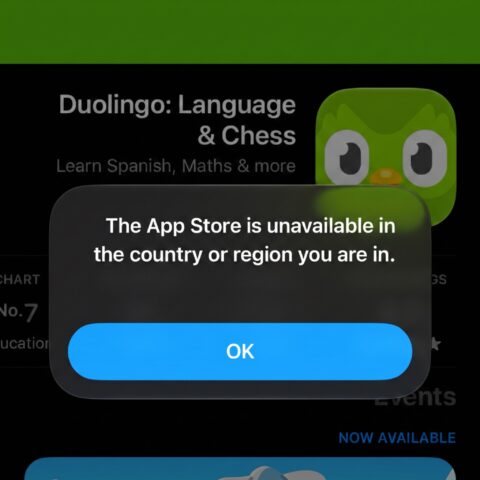
App Store message on the Duolingo listing, October 18, 2026.
The largest suppliers show how uneven access can be inside a single company. Of the 17 Microsoft services checked, seven are blocked, nine work for core use with another step failing or untested, and only Visual Studio Code is confirmed fully available. Teams opens from Syria, but in a September 2026 test its payment page never opened, and the Microsoft Store refuses a Syrian region. In February 2026, Microsoft’s export-controls team answered a volunteer’s request with an automated acknowledgement promising an update within 24 to 48 hours; later requests, the most recent in October 2026, have drawn nothing beyond one more acknowledgement. Meta follows the same pattern. Facebook, Instagram, and WhatsApp work for everyday use, but Meta AI, Meta Verified, and the developer platform are blocked, and in February 2026 Meta support told a volunteer both that Syria was still restricted and that it had been removed from the blocked list.
Overcompliance and De-risking
One striking feature of the current landscape is that many access barriers persist not through explicit policy decisions but through compliance configurations inherited from earlier sanctions periods and embedded in technical systems.
In practice, Syrian users encounter:
- Content delivery network geo-blocks (for example, Amazon CloudFront returning “configured to block access from your country”)
- Country exclusions in registration menus
- Identity verification workflows that do not accept Syrian documents
- Rejected Syrian phone numbers (+963)
- Payment-gateway incompatibility
- Outdated compliance pages and error messages still referring to sanctions programs that have ended
In some cases, Syria is simply absent from country selection menus during account creation. In others, services return legal-restriction errors referring to sanctions regimes that are no longer in force. These mechanisms create a form of “silent exclusion,” in which access fails at the interface level without any explanation or updated policy statement.
Some of these failures cascade far beyond the company that causes them. Twilio, one of the largest providers of SMS verification codes, confirmed in September 2026 that its block on Syrian (+963) numbers is a compliance restriction, not a missing carrier route, and that its geographic availability is unchanged. Developers building on such providers inherit the block. Firebase phone authentication, for example, refuses Syrian numbers with a generic “This operation is not allowed” error, so a Syrian developer is left auditing their own settings for a restriction they cannot change.
What Companies Say When Asked
Outreach conducted through the Unblock Syria platform, by its team and by community volunteers, shows that companies rarely cite a specific binding prohibition when explaining continued restrictions. Instead, they cite compliance uncertainty, partner dependencies, and internal risk policies.
Coursera declined in February and March 2026, citing a conservative compliance approach and restrictions from its own partners, and said Syria would stay blocked until conditions stabilize; a follow-up sent after the terrorism designation was rescinded has gone unanswered. Twilio told a volunteer it was not able to re-enter Syria, without identifying a regulatory obstacle. Salesforce stated in February 2026 that its “general treatment of Syria had not changed” and that access “remained prohibited,” and repeated the same position in August 2026, after the terrorism designation was lifted, still without naming a regulation. Udemy has declined repeatedly throughout 2026, most recently in September, citing its restricted-countries policy. JetBrains said in October 2026 that it is not offering services in the Syrian market “for regulatory compliance, operational and business reasons.”
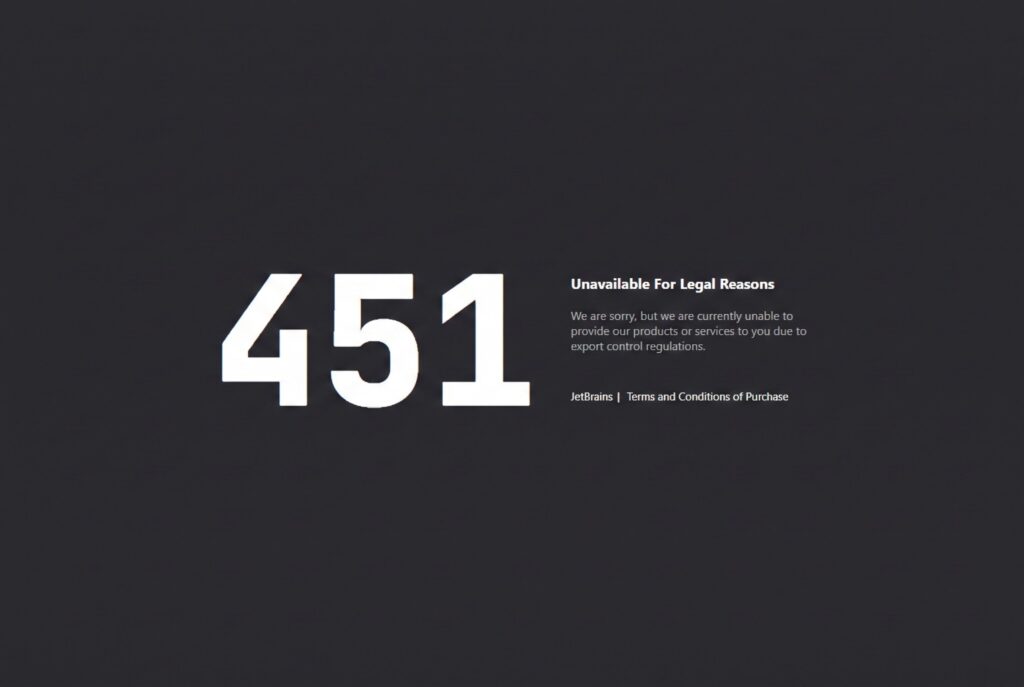
JetBrains error 451 on a PyCharm download, citing export control regulations, September 29, 2026.
Financial-service providers point to onboarding and risk frameworks. Airwallex stated that companies from Syria cannot apply for accounts and that it does not process transfers to Syrian banks. Coinify agreed in September 2026 that the sanctions landscape had changed materially, but kept Syria restricted on grounds of risk appetite and a high-risk anti-money-laundering classification.
Taken together, these responses suggest that restrictions persist less because of explicit legal prohibitions than because of unresolved compliance interpretations, third-party infrastructure dependencies, and risk-management choices that have not been updated since sanctions relief.
Evidence of Policy Inertia
Many restrictions persist because corporate compliance systems have not been updated. Several services continue to display sanctions-based messages referring to frameworks that are no longer in force. Zapier shows visitors from Syria a compliance notice stating that it stopped serving sanctioned countries, including Syria, in September 2024; after outreach, its legal and compliance team began reviewing the restriction in September 2026. In October, it said the review spans several teams and will take time. ManyChat shows visitors from Syria a page with error code 451, saying international regulations restrict its service and linking to OFAC, US export rules, and UK sanctions authorities. It has replied to outreach only with automated acknowledgements. Hack The Box declined in March 2026, citing EU and UK sanctions, even though the EU had lifted its economic sanctions on Syria and the UK had eased its own in 2025. A renewed request in August 2026 has had no recorded reply. As late as October 5, 2026, Firebase support told a volunteer that “under current US policies Firebase cannot be used from certain countries,” including Syria.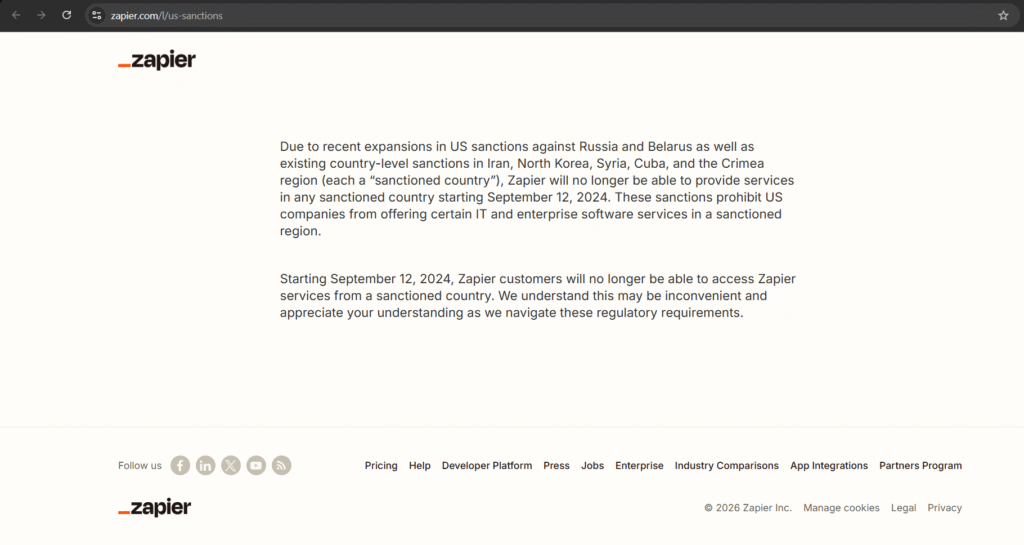
Zapier’s notice naming Syria, September 23, 2026.
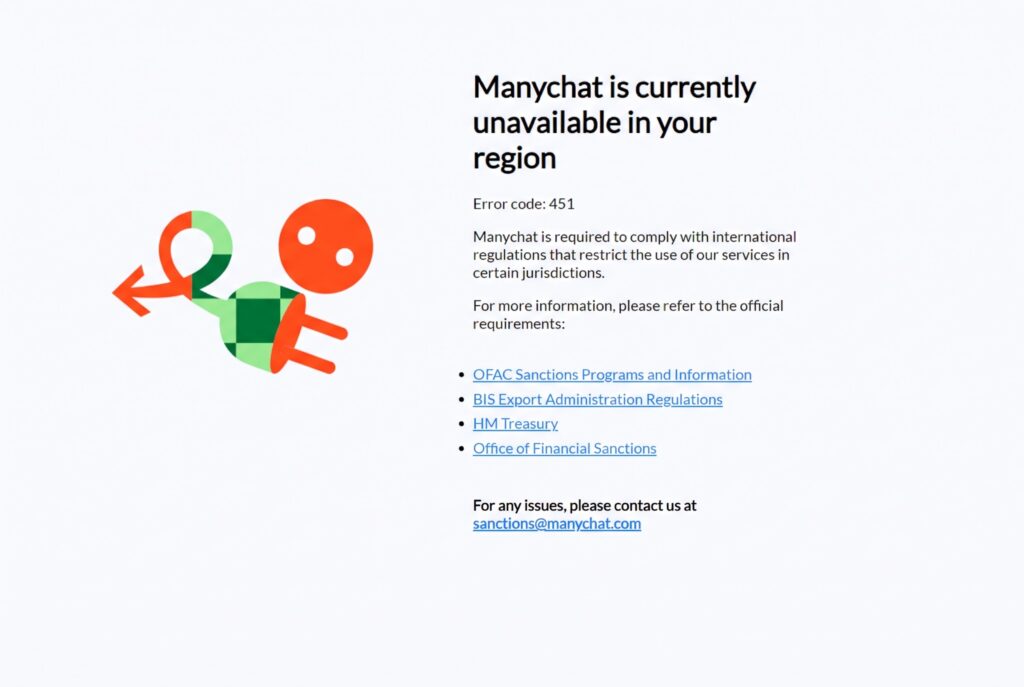
ManyChat’s error 451 page, September 29, 2026.
The clearest example of inertia is Atlassian. In March 2026 it cited EU and Australian sanctions; in September 2026 it cited US export rules pending an internal legal review. On October 6, 2026, its legal and compliance team concluded that Syria is not a blocked country under its export-control policy and that users in Syria are eligible to use its products. Yet the same week, a volunteer documented that atlassian.com, Jira, and Loom still refused Syrian connections through a CloudFront rule “configured to block access from your country.” The policy had changed; the configuration had not. By October 26, Jira, Bitbucket, and Trello worked from Syria, less than three weeks after the volunteer sent proof to Atlassian’s legal team. Loom was still blocked that day, and on October 30 Atlassian said its review was continuing.
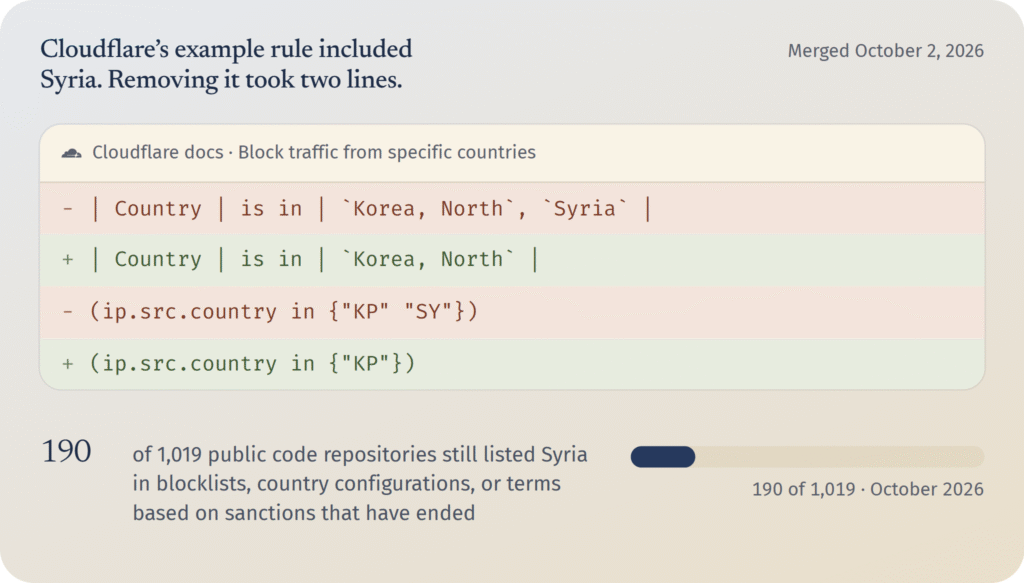
The same inertia spreads through shared technical templates. Cloudflare’s public documentation offered an example firewall rule for blocking traffic by country that listed North Korea and Syria, and developers copy such rules directly into their own configurations. An open-source AI agent skill for setting up web application firewalls, in a repository starred by more than 48,000 GitHub users, contained the same kind of example, so an AI coding agent following it could write a Syria block into a real configuration. After Unblock Syria’s founder opened pull requests, both were corrected on October 2, 2026, one within about seven hours (agentic-awesome-skills #1755) and the other within a day (cloudflare-docs #33922). Nobody had decided to block Syria in either case: the list had been copied and never questioned. A wider search of 1,019 public code repositories in October 2026 found 190 that still listed Syria in blocklists, country configurations, or terms based on sanctions that have ended.
The Role of the Unblock Syria Initiative
By November 4, 2026:
- 1,236 international services were being tracked, most of them added from community submissions
- 404 companies had been contacted by Unblock Syria and its community
- 42 services had been recorded as restored; core use has been confirmed working on 27 of them, and every step has been confirmed working on four of those
- 170 more had a company reply or a review in progress
This evidence base shows both the scale of the remaining restrictions and the slow pace at which companies are adjusting their compliance frameworks to the new sanctions environment.
It also shows that barriers can be removed quickly once someone reviews them. Kaggle’s IP block was gone by March 2026, after a volunteer’s appeal. Hostinger’s legal department confirmed restored availability in February 2026 following an internal sanctions review. AMBOSS restored access after its own compliance review, and Binance opened to Syrian residents in June 2025, though its registration page returned an error in a September 2026 test. Of the 42 services currently recorded as restored, only 18 followed a recorded outreach request, and five more followed a community member’s own report of contacting the company; the other 19 came with no recorded contact.
Restoration is also not always complete. Kaggle’s identity verification still fails for Syrian users, and Hostinger’s checkout still rejects payment. Reopening the front door often leaves the payment and verification layers untouched.
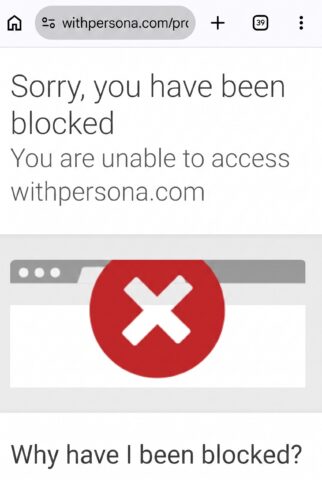
Persona, Kaggle’s identity checker, blocking a visitor from Syria, September 27, 2026.
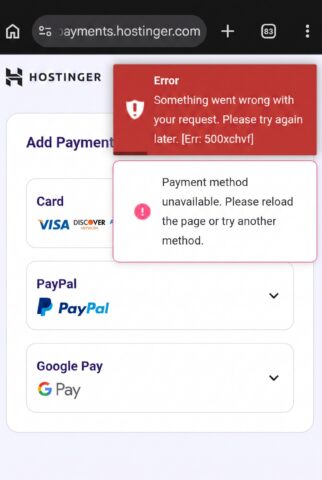
Hostinger’s checkout rejecting payment from Syria, September 14, 2026.
Taken together, these findings indicate that Syria’s continued exclusion from major digital platforms reflects a structural lag between formal sanctions termination and operational access, one that affects not only individual services but the broader ecosystem through which users participate in education, employment, and digital markets.
3. “Sanctions Hangover” and Implications
The persistence of digital access restrictions in Syria despite the lifting of comprehensive sanctions can be understood as a “sanctions hangover”: the uncertainty, reputational risk, and compliance fears that persist after formal restrictions are removed. Even after legal barriers are lifted, firms face uncertainty about residual export controls, overlapping regimes across jurisdictions, banking-sector exposure, and the reputational cost of re-engaging with a previously sanctioned market. As a result, companies often keep restrictive access policies by default, producing a gap between formal sanctions termination and effective digital reintegration.
Evidence That the Problem Is Systemic
The persistence of digital exclusion is not limited to individual platforms but reflects a broader structural pattern across the digital ecosystem.
Restrictions appear across all major categories of digital services, including artificial intelligence tools (ChatGPT, Claude), education platforms (Coursera, Udemy), payment infrastructure (PayPal, Stripe), collaboration tools (Slack), developer tools (JetBrains), and cloud services (Amazon CloudFront). The breadth of sectors affected indicates a shared compliance logic rather than isolated commercial decisions.
Access barriers also operate through infrastructure layers that extend beyond individual platforms. Payment processors’ country lists prevent purchases across many downstream services, while Apple Pay, Google Pay, and Wise remain unavailable, limiting the ability of Syrian users to participate in digital markets even where platforms themselves are technically accessible.
Identity checks sit earlier still, stopping account creation before a platform’s own policy even becomes relevant.
These barriers persist despite sustained outreach. By November 4, 2026, Unblock Syria and its community had contacted 404 companies. For 374 services, the latest request had gone unanswered for at least 30 days, and companies had declined on another 78.
4. Human Impact
“I expected to run into challenges with electricity, infrastructure, or basic services. What I did not expect was that the thing weighing most on my decision would be something you cannot see: digital services blocked inside Syria.” —Taimullah Kellizy, computer science student, after ten days in Syria
Restrictions on digital services in Syria are not abstract compliance issues. They shape how students learn, how freelancers work, how businesses operate, and how professionals access knowledge. Cases documented by the Unblock Syria initiative show how platform-level barriers translate into everyday economic constraints.
A Syrian medical student needed a two-minute notarization to open the account his certification abroad depends on. Elsewhere it is done online from home; for Syrians, that option does not exist, so it required a border crossing, days in Amman, and at least USD 260. A freelancer who registered on Toptal had the account suspended the moment they selected Syrian nationality. A computer science student who returned home for ten days after thirteen years away reported that what weighed most on the decision to return was not electricity but blocked services.
Students: Barriers to Learning and Skills Development
Students are among the most affected. A computer science student in Damascus reported being unable to subscribe to paid AI coding tools because their checkouts do not accept payments from Syria. Some AI assistants have become reachable recently, but even where a service opens, the absence of working payment infrastructure prevents users from subscribing independently to professional tools.
To work around these restrictions, students often rely on free VPN services, which can be unreliable and may expose users to data-security risks. VPN use can also lead to account suspension for apparently violating platform rules.
Similarly, self-taught developers following professional training programs on Coursera or Udemy described obtaining course material indirectly through contacts abroad because direct platform access remained blocked. Even where workarounds were possible, they could not earn certificates in their own name, undermining their ability to demonstrate qualifications to employers.
These barriers reduce the effectiveness of self-directed education pathways that are otherwise central to digital-sector employment in low-income and conflict-affected contexts.
Freelancers: Lost Contracts and Payment Barriers
Restrictions on collaboration platforms and payment infrastructure have significant consequences for freelancers working with international clients. A freelance designer in Aleppo reported losing contracts because Figma remained inaccessible from Syria, making real-time collaboration unreliable even through VPN connections.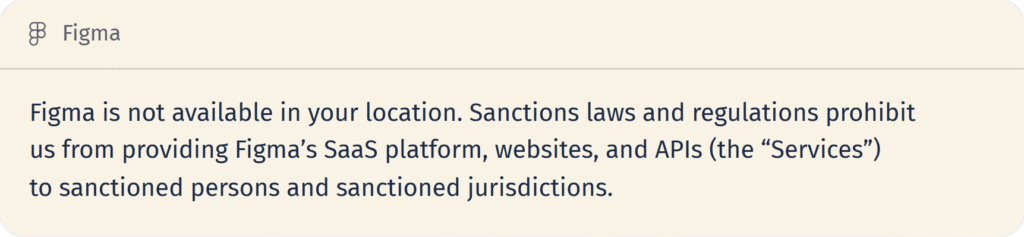
Figma’s sanctions notice, September 19, 2026.
The continued blocking of PayPal also forced payments to be routed through relatives abroad. At first glance, this may appear to solve the problem, since having a relative with a foreign bank account is often the easiest part. The main difficulty is that many payment platforms require the person receiving the money to be the person who provided the service, or to be listed as the ultimate beneficiary. When a relative receives the funds instead, this creates a compliance problem for both sides. The platform may reject the transfer, freeze the account, or suspend access because the recipient does not match the service provider. It also puts relatives at risk, as they may appear to be receiving business income on someone else’s behalf. The bigger barrier is therefore not simply the cost or delay of routing funds abroad, but the fact that this workaround is often incompatible with platform compliance requirements and prevents freelancers from participating reliably in legitimate international work.
The combination of technical exclusion and financial friction raises the cost of cross-border participation in remote work and reduces the credibility of Syrian freelancers as reliable partners in distributed teams. Because remote work is one of the few scalable employment pathways available in conflict-affected economies, these restrictions have disproportionate economic effects.
Small Businesses: Reduced Access to Global Markets
For small business owners, restrictions on cloud hosting, payment gateways, and collaboration tools translate directly into reduced productivity and lost customers. An e-commerce entrepreneur in Latakia reported being unable to use AWS for hosting, Stripe for online payments, or Slack for supplier coordination. The business turned to higher-cost hosting abroad, replaced structured communication tools with WhatsApp groups, and limited transactions to local bank transfers, losing most of its potential international customers.
Researchers and the Cost of Knowledge Isolation
A medical researcher in Damascus described relying on a colleague’s VPN-enabled device to use ChatGPT, reflecting the difficulty of maintaining stable and secure access. The researcher was also unable to obtain continuing-education certificates through Coursera because platform access remained blocked.
Implications for Economic Recovery and Inclusive Governance
Taken together, these cases show that digital access restrictions are not limited to individual inconvenience but shape the broader trajectory of economic recovery and institutional inclusion.
First, barriers to payment infrastructure and developer tools restrict participation in remote labor markets that could otherwise provide foreign-currency income and employment independent of domestic economic conditions.
Second, the continued exclusion of Syrian users from educational platforms undermines the development of technical skills needed for reconstruction, public administration reform, and private-sector growth.
Third, restrictions on collaboration platforms and authentication systems weaken the ability of Syrian professionals to participate in international research networks, civil-society initiatives, and policy dialogue.
Finally, the uneven availability of digital tools risks reinforcing inequality between those with access to external intermediaries—such as diaspora networks, foreign bank accounts, or stable VPN connections—and those without them. In this way, the sanctions hangover does not affect all users equally; it redistributes opportunity toward those already connected to cross-border support structures.
Restoring access to digital platforms is therefore not only a technical or regulatory issue. It is a prerequisite for participation in the knowledge economy and for more inclusive economic governance in the post-sanctions environment.
5. What Can Be Done?
The persistence of digital access restrictions in Syria is not primarily a legal problem. As the Unblock Syria data shows, many barriers remain because company compliance systems, payment infrastructure, and verification tools have not been updated since sanctions relief. Restoring access does not require new legislation in most cases but clearer guidance and targeted action from both companies and policymakers.
What Policymakers Can Do
1) US Regulators
- The Bureau of Industry and Security (BIS) should complete the export-control changes that follow the rescission of Syria’s terrorism designation, removing Syria from Country Group E:1 and confirming that mass-market software, consumer cloud services, AI assistants, developer tools, and education platforms can be provided to users in Syria without an individual license.
- The Treasury, State, and Commerce Departments should update their joint Tri-Seal Advisory on Syria sanctions relief with explicit guidance for digital-service providers, confirming that no remaining US measure requires blanket geo-blocking of general-purpose digital services, exclusion of Syrian users from payment infrastructure, or restrictions on subscriptions to education platforms, developer tools, and AI services, beyond the screening of listed persons that applies everywhere.
2) Syrian Government
- The Ministry of Communications and Information Technology said in late August 2026 that it had formally notified companies of the terrorism designation’s removal and asked them to review geographic restrictions on Syrian users, including access to services, account creation, and payment gateways. The ministry said its outreach to major technology companies in recent months had helped restore some services, and that the effects would be gradual because each company must update its own policies.
What Companies Can Do
- Restore access to free-tier services where payment functionality remains restricted. Product and access-policy teams should enable browsing, educational content, and non-commercial developer tools while payment eligibility is updated.
- Update country eligibility lists immediately. Remove Syria from sanctioned or embargoed country lists in compliance databases, country selectors, CDN geo-block configurations (CloudFront, Cloudflare WAF), and Terms of Service, and check public documentation and code examples that others copy.
- Clarify internal compliance guidance. Compliance teams should revise eligibility rules to reflect the termination of the US Syria sanctions program, the rescission of the terrorism designation, and License Exception SPP.
- Enable support for Syrian phone numbers (+963) and identity documents. Identity-verification providers and onboarding teams should add Syria to supported regions for two-factor authentication, KYC, and account recovery.
- Publish a Syria access policy. Legal and compliance teams should state publicly whether services are available, partially available, or restricted for users in Syria, and on what basis.