As of today, we still don’t know Syria’s GDP, unemployment rate, and several other basic indicators. These are not numbers you can improvise. They require official surveys that have not yet been carried out, for reasons that are, in many cases, understandable.
What is much harder to excuse is stopping the publication of data that was already available. Inflation is one example. Those figures stopped being published after the regime’s fall, beginning in February 2025.
More broadly, the real problem is the pretense of knowledge.
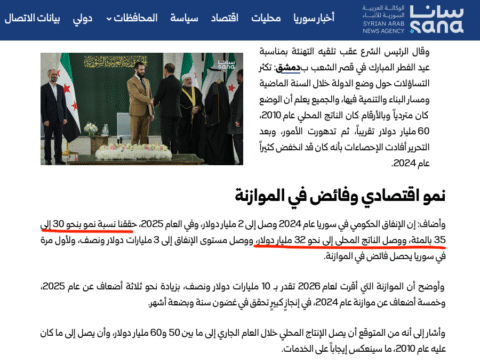
In March, the Syrian president claimed, citing the finance minister’s assessment, that Syria’s GDP grew by 30-35% in 2025, reaching $32 billion
But in February, the same finance minister said growth in 2025 was around 5٪. That is a much more plausible number, in my view.
So which is it: 5٪ or 35٪?
Throwing numbers has consequences. The most important one is that future claims made by the Syrian government will stop being taken seriously by Syrians, investors, foreign governments, and international institutions.
It gets worse. When the Ministry of Finance publishes a budget summary showing expected GDP for 2026 at $33.7 billion, that can easily be read as an extraordinary collapse in growth momentum, from 35٪ in 2025 to just 5٪ in 2026.
GDP is an example of a wider problem.
There is no need to pretend that we know everything.
Sometimes the most responsible answer is simply: we don’t know.