

Within hours of opposition fighters arriving in Damascus on 8 December 2024, Israeli military forces launched a large-scale ground operation into Syria, taking control of the 50-year-old demilitarized zone and advancing deeper into parts of western Daraa and Quneitra. In total, approximately 350 square kilometers of territory were captured, stretching from Mount Hermon in the north to a strip of Daraa’s Yarmouk Basin in the south. Over the same 48-hour period, Israeli fighter jets launched at least 350 airstrikes across Syria, targeting former regime military infrastructure. Hundreds more strikes followed through the remainder of December, with nearly 1,000 recorded in total as of 8 December 2025.
In 2025, having consolidated control over this expanded “buffer zone,” Israeli military forces launched hundreds of ground incursions into Syria, according to data collected by Syria Weekly. At least nine Israel Defense Forces (IDF) bases have also been established and constructed inside newly occupied Syrian territories (see map below).
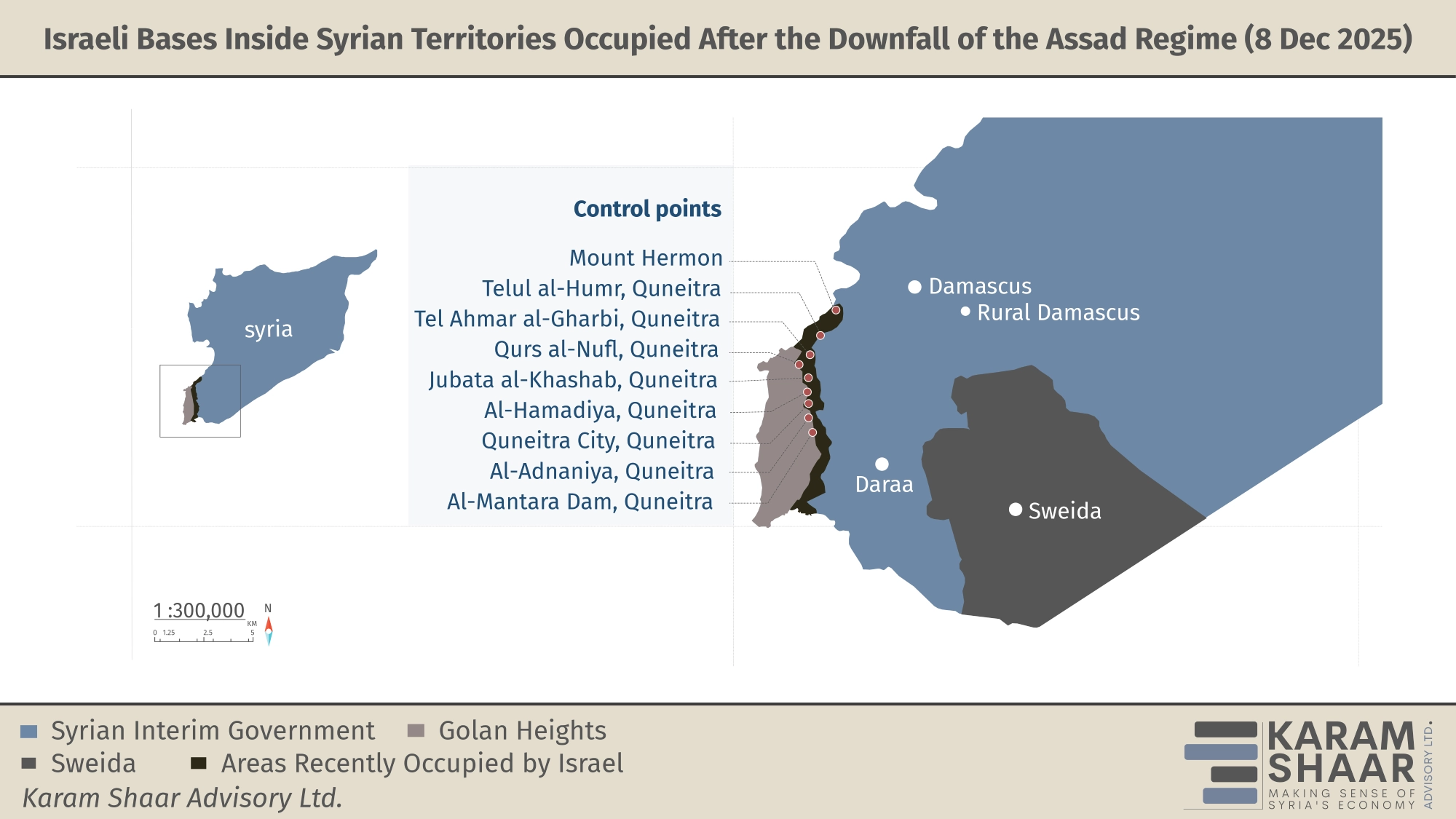
Initially, Israeli ground incursions into southwestern Syria involved the destruction of former Assad regime military bases and posts, followed by the construction of new military infrastructure. These operations included the laying of minefields, the seizing and demolishing of homes, the forcible displacement of civilians, and the clearing of agricultural land and forested areas. This process has included the razing of more than 110 acres of the historic Jubata al-Khashab forest, as well as the depopulation of and restrictions on local Syrian access to vast stretches of agricultural land. Farmers and herders who have attempted to enter or use their land within sight of Israeli lines of control have frequently been subjected to live fire. In a profoundly rural region, the local agricultural sector has been crippled.
Since June 2025, an average of 17.5 Israeli ground incursions have been conducted each week. These incursions typically involve armored patrols through populated areas, followed by the establishment of temporary checkpoints on main roads, where all passing Syrian civilians are stopped, searched, questioned, and have their phones examined. In some cases, biometric data is also collected. Incursions also routinely include military raids on residential buildings, commercial businesses and, at times, schools. Dozens of Syrian men have been extrajudicially detained by IDF forces and taken into Israeli territory for interrogation—often to be released in rural areas and left to find their way home a day or two later. At least a dozen men remain in Israeli detention, with their whereabouts unknown.
Throughout the past year, the Syrian government’s only response to Israel’s actions has been to issue public statements of condemnation through the Foreign Ministry and to file complaints with the United Nations. Although not acknowledged publicly, Syrian Interior Ministry officers stationed in Daraa maintain lines of communication with Israeli counterparts, and during periods of heightened tension, such communication has occurred at the ministerial level. Nevertheless, there is a significant risk that Israeli actions may ultimately prove self-fulfilling, whereby sustained measures taken against a non-existent threat could contribute to the emergence of a real one.