
By: Karam Shaar
The Directorate of Companies at Syria’s Ministry of Economy and Industry recently released business formation data for 2024, 2025, and the first half of 2026, showing increases in registrations across all major categories. In the absence of higher-frequency indicators such as FDI or capital investment, company incorporations provide a rough read on entrepreneurial activity.
Total registrations more than doubled, from 8,675 in 2024 to 18,023 in 2025. Based on 10,521 registrations in the first half of 2026, an annualization (H1 × 2) would put the 2026 total at 21,042, 16.8% above 2025.
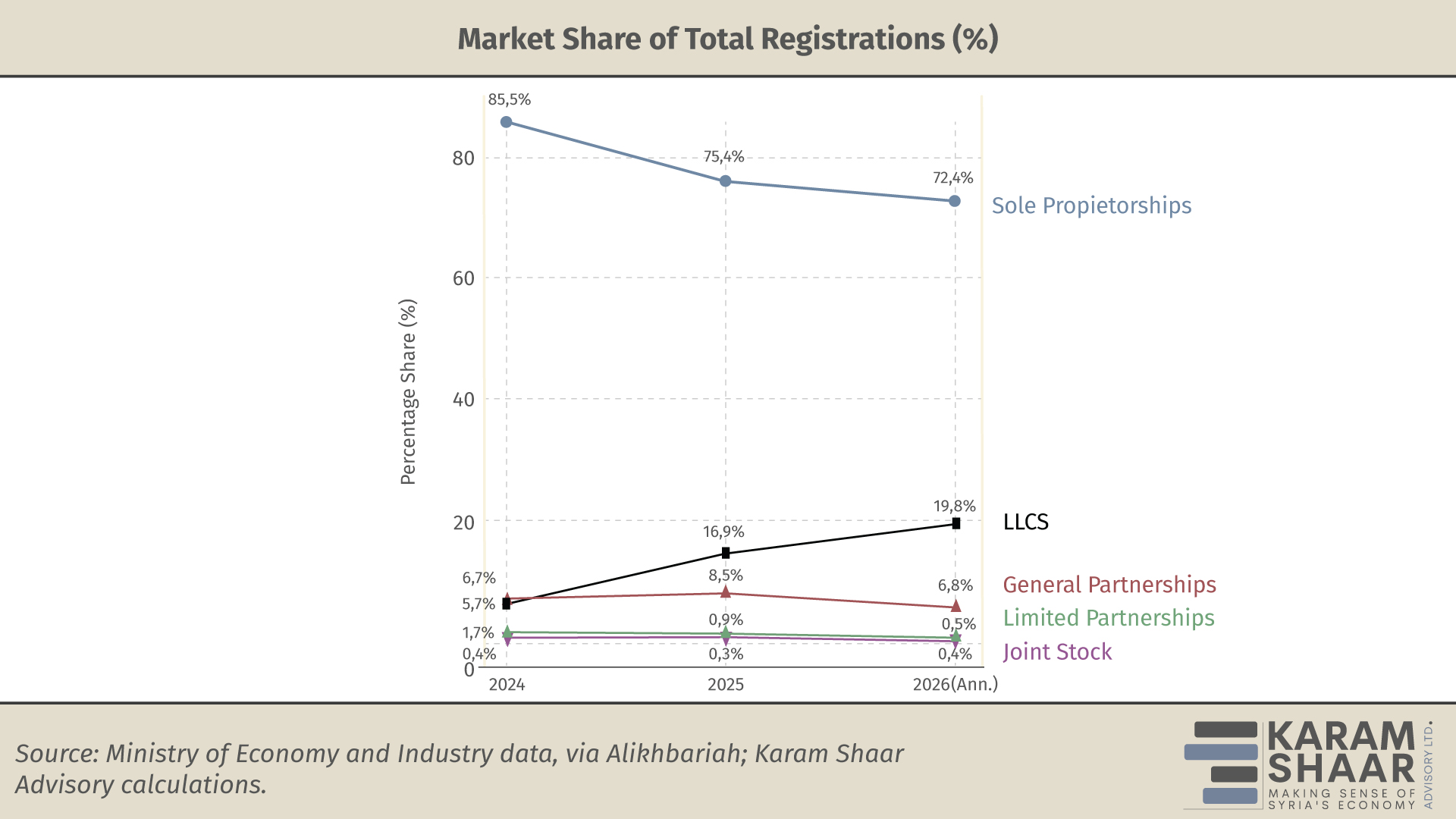
More significantly, however, is the changing composition of new registrations (see chart). LLCs accounted for 5.7% of registrations in 2024 but would reach 19.8% in 2026, with registrations rising from 497 to an annualized 4,174. Meanwhile, sole proprietorships made up of sole traders without a separate legal personality increased in absolute numbers but fell from 85.5% to 72.4% as a share of total registrations.
The increase in LLC registrations is particularly significant because LLCs allow capital to be pooled without personal exposure and have a minimum capital requirement of SYP 50 million. This means that LLCs start from a larger capital base and inject more upfront capital into the economy.
Other company forms show mixed trends. General partnerships peaked at 1,526 registrations in 2025 and are falling in 2026. Simple limited partnerships are also falling: 144 in 2024, 158 in 2025, and 56 in the first half of 2026. Joint-stock companies rose from 33 registrations in 2024 to an annualized 92 in 2026 but remain under half a percent of total registrations.
Overall, the ministry attributed the rise in the total number of registrations partly to new policies, simplified administrative procedures, and the introduction of a single-window system. These changes may have encouraged new registrations, but they may also have made it easier for previously informal businesses or those that had delayed registration to register.
Still, registration data should be read carefully. Registrations may signal intent rather than activity: registered firms may never trade, regulatory changes can inflate or defer filings, and the figures say nothing about employment, revenue, or investment. Capital is also an imperfect guide, but it provides a floor: an LLC incorporated with the statutory minimum of SYP 50 million may in fact be considerably larger.