By: Roua Obaid
The fall of the Assad regime has reshaped captagon production and trafficking in Syria. Seizure operations by the new authorities have disrupted trafficking networks and supported Syria’s regional and international economic reintegration.
Yet persistent captagon activity in southern Syria highlights broader policy limitations.
Syria’s captagon sector has been significantly disrupted. According to data from the New Lines Institute, the average number of pills per seizure rose sharply after the regime’s collapse. In 2024, Assad’s last year in power, the average seizure contained 220,000 pills. In 2025, that figure rose to 2.1 million pills—nearly 10 times higher.
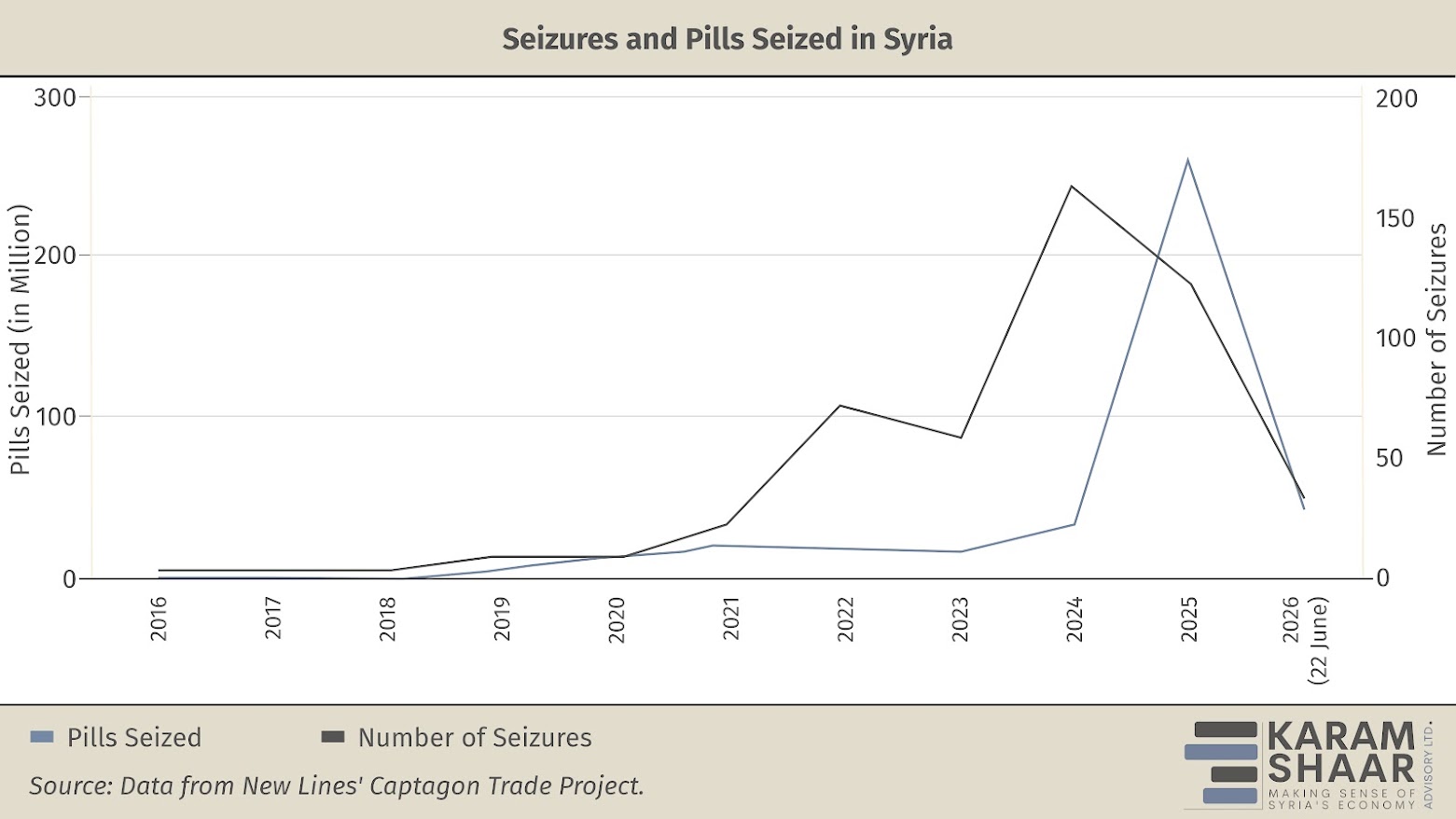
Yet remnant operations persist where weak institutions and economic deprivation intersect with insecure local conditions. This is most visible along Syria’s southern border with Jordan, particularly in Daraa and As-Suwayda governorates, where de facto territorial fragmentation, fragile security, and economic deprivation have enabled elements of the captagon trade to endure.
With state sponsorship gone, trafficking networks have shifted from the large-scale production and smuggling model cultivated under Assad to smaller, dispersed, lower-capacity clusters. This shift is evident in recent seizure data from Jordan, which shows a rise in small aerial shipments relative to land-based trafficking. Seizures of GPS-tracked thermal balloons account for 82 percent of border interceptions in Jordan since December 2024. A single balloon can transport up to 120,000 captagon pills—far fewer than the Assad-era truck shipments that often carried millions of pills at once.
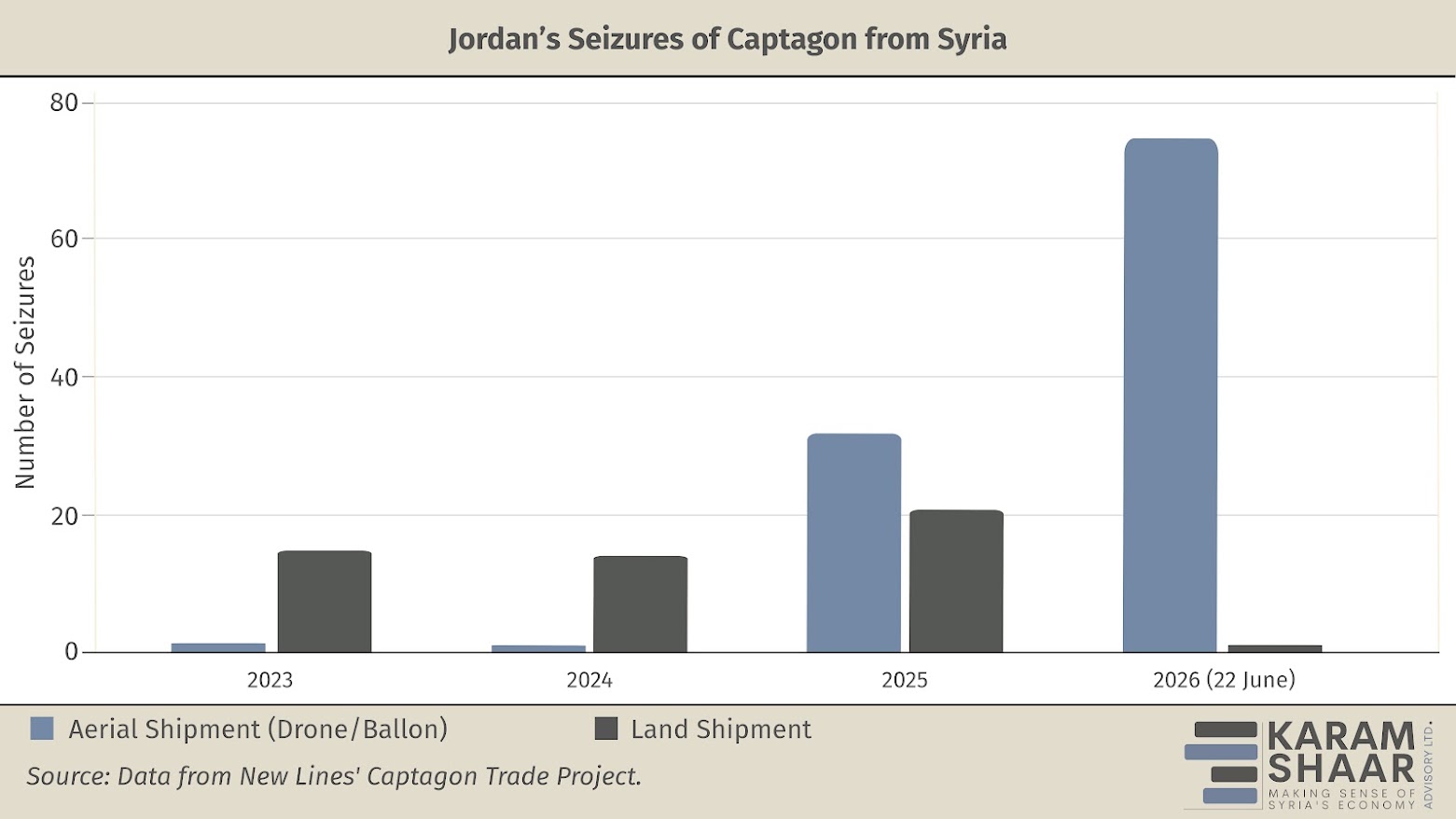
At the same time, available seizure data does not permit a definitive assessment of the geographic origins of continued captagon activity. The Syrian-Jordanian border spans four governorates and includes open, rugged, and mountainous terrain. As a result, it is difficult to determine whether intercepted balloon shipments originate in Rural Damascus via the Badia region, As-Suwayda, Homs, or Daraa. Instead, field sources and earlier independent research indicate that this trade is sustained by resilient local networks that cut across governorate boundaries, as well as ethnic, sectarian, and military alignments.
Dismantling the remnants of Syria’s captagon sector will require stronger local institutions, measures to mitigate economic deprivation, and a more nuanced security approach tailored to the complex dynamics unfolding in southern Syria.