

When Bashar al-Assad’s regime fell on 8 December 2024, ISIS was nearing the end of its first full year of sustained resurgence in Syria since its territorial defeat in early 2019. Between 1 January and 1 December, the group carried out at least 660 attacks across Syria—an average of 60 attacks per month—according to Syria Weekly data. That 2024 operational tempo was triple the rate recorded in 2023. Beyond attack numbers, ISIS was also becoming more confident and tactically sophisticated.
Throughout 2024, ISIS increasingly employed explosive devices—including vehicle-borne improvised explosive devices (VBIEDs)—while deploying larger numbers of fighters in each operation. This demonstrated a greater willingness to accept casualties, implying that recruitment was once again growing. The group also mounted more daring, full-frontal assaults on fixed enemy positions. ISIS’s extortion network had re-emerged as well, with enforcement-style attacks on businesses that refused to pay the group’s “tax,” suggesting a deeper entrenchment within local communities, particularly in Deir Ezzor.
Despite this resurgent year, the fall of Assad’s regime proved a shock to ISIS’s system. Having long exploited Syria’s desperation and sectarian divisions to justify its presence and recruit members, ISIS suddenly faced a transformed environment. The new transitional government offered a path out of conflict and political representation for Syria’s Sunni Arab majority—posing a potentially existential challenge to ISIS’s modus operandi.
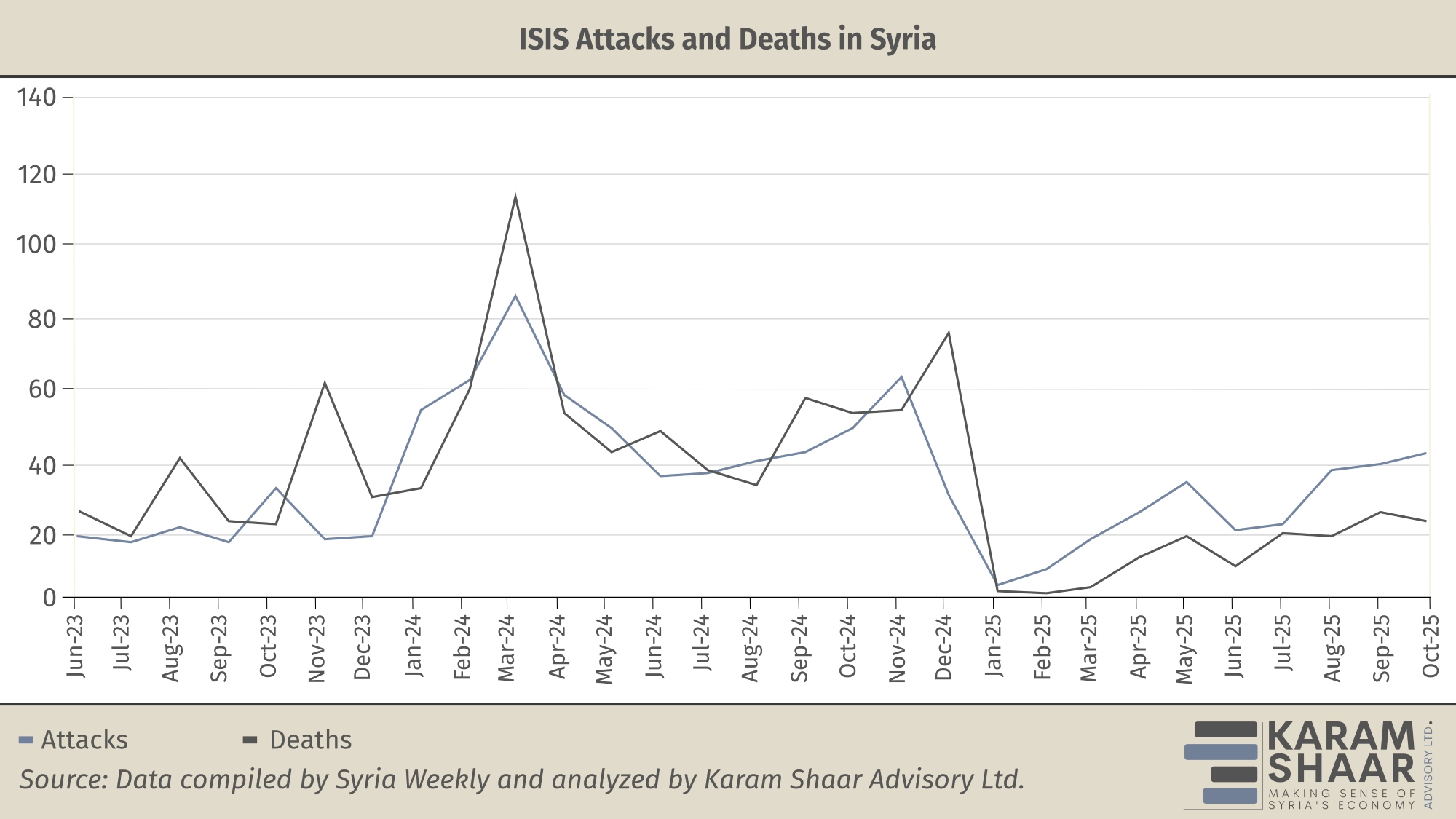
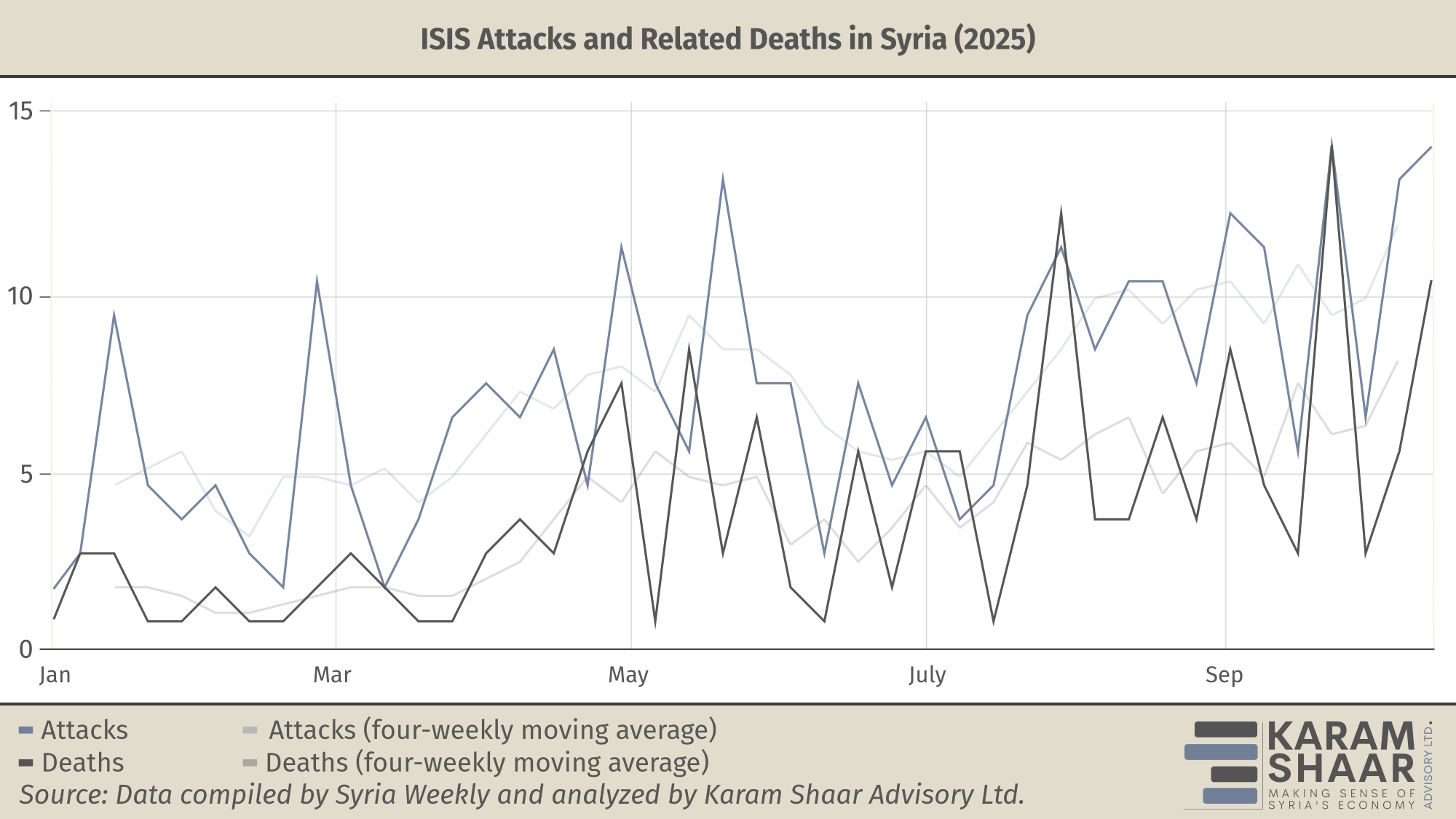
Consequently, between 1 January and 1 April 2025, ISIS’s operational tempo plummeted to an average of just ten attacks per month, while the deadliness of its operations fell to roughly one death per month—down from 63 in 2024. During this period of relative inactivity, ISIS appears to have regrouped; attacks and fatalities rose steadily through May, paused briefly, then increased again from July through September.
In post-Assad Syria, ISIS has pursued two parallel tracks of violence—an insurgent campaign in areas controlled by the Syrian Democratic Forces (SDF) in the northeast, and an urban terrorist campaign in government-held zones. Between 1 January and 1 October, 89 percent of the 237 ISIS attacks recorded by Syria Weekly occurred in SDF territory. While most attacks were carried out with small arms and light weapons (including rocket-propelled grenades, or RPGs), the group also used seven improvised explosive devices (IEDs) and four suicide vests between 1 August and late September. This demonstrates continued access to explosives, the expertise to manufacture them, and the freedom to transport and deploy them—a typical indicator of a maturing insurgency with rising capacity.
Given that nearly 90 percent of all ISIS attacks occur in SDF-held areas, the SDF itself is clearly the group’s primary target. Widely perceived as a Kurdish-led force representing a Kurdish cause, the SDF presents ISIS with an exploitable opportunity; undermining its authority could deepen ethnic and sectarian fault lines that breed instability and facilitate ISIS recruitment. This alone highlights why integrating the SDF into the state remains vital if Syria and its partners are to achieve a strategic defeat of ISIS.
Deir Ezzor remains the epicenter of ISIS operations, accounting for 76 percent (185 of 244) of all attacks in 2025. In 2024, ISIS placed heavy emphasis on targeting oil transport within and out of SDF areas, but such attacks have since declined to about 7 percent of total operations this year.
The most concerning trend in 2025 is the recent rise in attack lethality. Between 1 January and 29 September, 78 ISIS attacks in Syria caused at least one fatality. Of these, 35 (45 percent) occurred between 1 January and 31 July, while 43 (55 percent) occurred between 1 August and 20 October. Notably, 37 percent of all fatal attacks this year took place in the final six weeks of reporting—evidence of a sharp recent increase in ISIS’s capacity to conduct deadly operations in terms of targeting, manpower, weaponry, and willingness to absorb losses.
Beyond these attacks, senior sources in Syria’s Interior Ministry told Syria in Figures that 13 large-scale, potentially mass-casualty plots against minority religious sites, returning refugees, and public holiday gatherings were foiled in 2025—many through intelligence shared by the United States and other regional partners.
Damascus’s ability to disrupt almost all ISIS plots—aside from one suicide bombing that killed 30 people at Mar Elias Church on the outskirts of Damascus on 22 June—illustrates the Interior Ministry’s deep penetration of ISIS networks. This is unsurprising, given that Interior Minister Anas Khattab previously led Hayat Tahrir al-Sham’s campaign to defeat ISIS cells and al-Qaeda loyalists in Idlib between 2018 and 2024. However, Damascus’s success also reflects a burgeoning intelligence and military relationship between Syria and the United States—channeled through covert coordination with the Interior Ministry and soon to expand into military channels following the visit of US Central Command chief Vice Admiral Bradley Cooper to Damascus on 12 September. Talks are also under way to include Syria in the US-led Global Coalition to Defeat ISIS.
This emerging bilateral security relationship will be crucial in shaping the next phase of the counter-ISIS campaign in Syria. That ISIS was resurgent in both SDF- and Assad-held areas in 2024, but has since concentrated almost entirely in SDF territory after Assad’s fall, is analytically significant. If ISIS is to be defeated decisively in Syria, the campaign cannot be waged along a dividing line that splits the country into two battlefields. While the SDF’s dedication and sacrifice in the fight against ISIS have been remarkable, its Kurdish leadership and secular ideology do not offer a viable long-term alternative to ISIS. A unified Syria under a broader and more representative transitional government could. It is therefore essential that the current impasse in negotiations between Damascus and the SDF be broken and that talks progress toward a comprehensive agreement in which the SDF and its autonomous administration dissolve and integrate equitably into the state.