By: Ben Fève
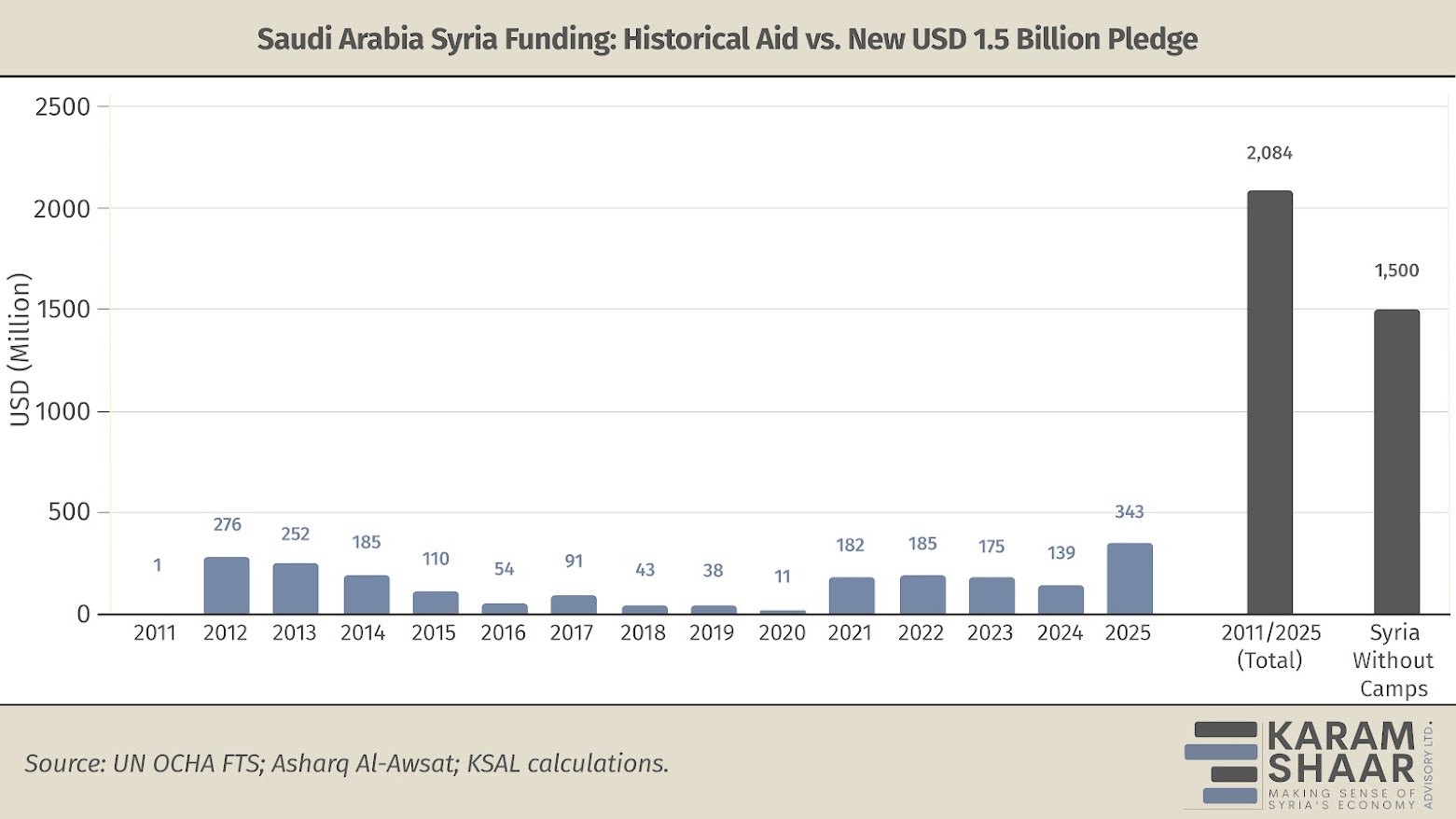
Saudi Arabia’s announced USD 1.5 billion pledge would be around 4.4 times its highest FTS-reported annual Syria-related contribution and would be equivalent to roughly 72% of all reported Saudi Syria-related funding from 2012 to 2025.
Between 2012 and 2025, Saudi Arabia reported around USD 2.08 billion in Syrian-crisis-related funding to UN OCHA’s Financial Tracking Service. The largest single year was 2025, at $343m. The new USD 1.5 billion pledge is therefore unusually large.
The announced Saudi support marks a major scale shift. If implemented in full, the USD 1.5 billion pledge would dwarf Saudi Arabia’s previous annual Syria-related funding reported to FTS. It is 4.4 times larger than the 2025 peak and roughly 10 times the 2012–2025 annual average. The anomaly is not just the amount, but the move from relief funding toward state-led recovery financing.
But is this really new funding? The pledge appears linked to Saudi Fund for Development discussions earlier in 2026, when Syrian officials outlined a phased financing package of up to USD 1.5 billion across health, education, water, energy, housing, disaster management, telecoms, and MSME support. The latest announcement likely operationalizes that envelope through the “Syria Without Camps” initiative and via Presidential Decree No. 59 of 2026, which established a committee tasked with preparing infrastructure in damaged areas ahead of the planned return of residents, rather than representing a clearly separate commitment.
The pledge is a delivery test for both Riyadh and Damascus. For Syria, it could accelerate camp closures, service rehabilitation, and investment in return areas. But the disbursement timeline, financing mechanisms, oversight structure, and implementation model remain unclear. The initiative will also test Saudi Arabia’s willingness and capacity to move from political support and announcements toward large-scale operational financing inside Syria. Success could encourage further direct recovery funding from regional and international actors, while failure would reinforce concerns over transparency, coordination, and implementation capacity.