By: Mohamad Ahmad
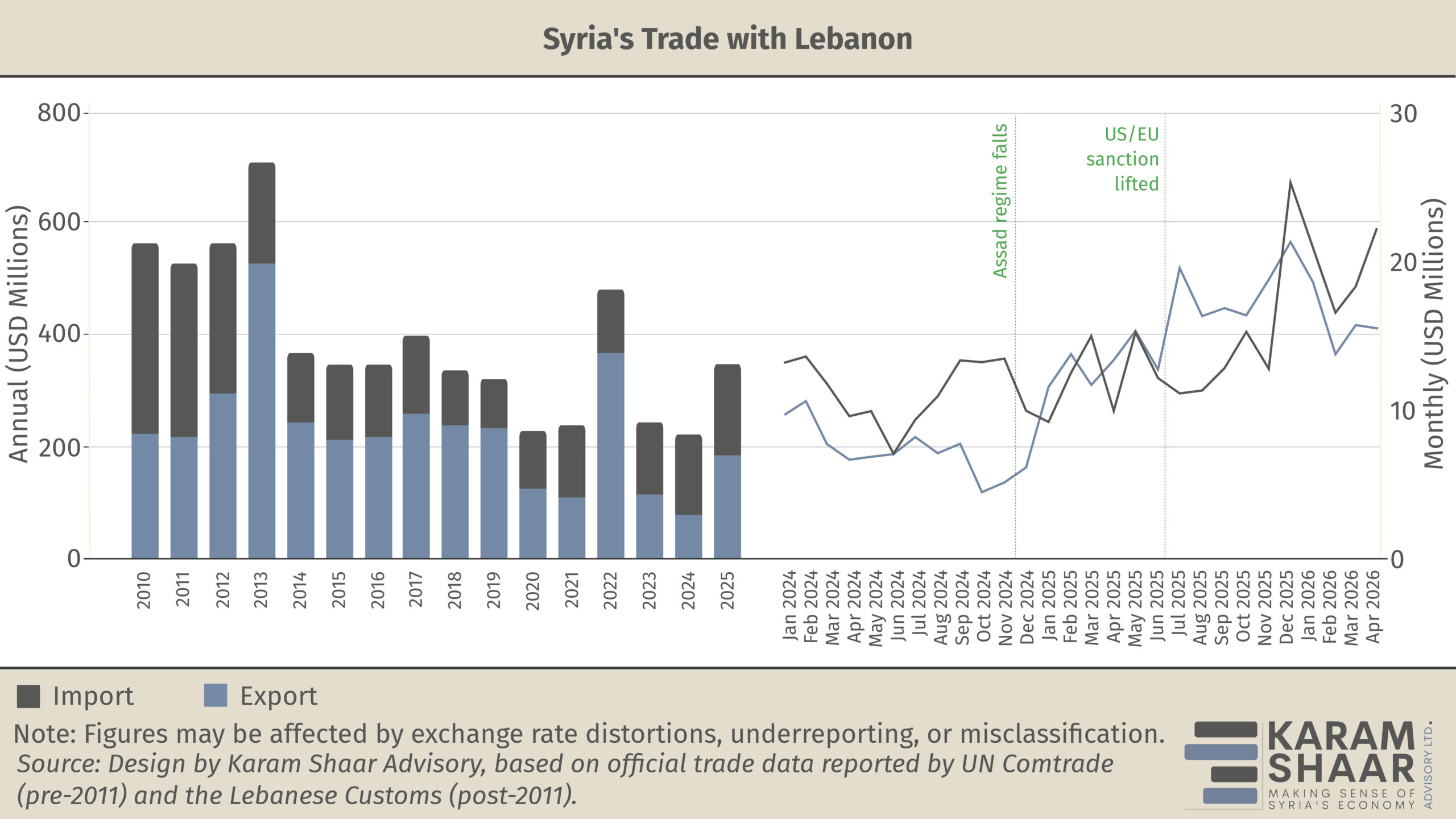
In 2025, Syria and Lebanon recorded USD 347 million in formal bilateral trade, up from 2024. Our analysis of mirror trade data (data reported by one country about its trade with another) from Lebanese Customs identified two key observations.
First, reported trade between Syria and Lebanon is recovering, but the growing bilateral deficit highlights the asymmetry in Syria’s recovery. Syria mainly imported plastics, fruits, and machinery, indicating demand for consumer goods and production equipment, while exporting lead, vegetables, glass, and soap, reflecting its limited productive base. Imports have risen faster than exports, pushing Syria back into deficit with Lebanon in 2025 after small surpluses in 2023 and 2024. After sanctions were eased and the patronage-security networks that had long extracted payments at and controlled the main crossings were dismantled, formal trade began to recover. Syria’s exports also grew far more modestly, reflecting the severe damage inflicted by 14 years of conflict on its productive capacity.
Second, although overall smuggled volumes cannot be precisely measured, the apparent trade recovery partly reflects a transition from informal to formal trade for some goods. Official customs records capture only part of actual trade. Smuggling between Syria and Lebanon predates 2011 and has long been part of border communities’ economies, where informal flows included fuel, agricultural produce, and cheap manufactured goods moving into Lebanon. After 2011, the direction often reversed: fuel subsidized in Lebanon, flour, medicine, and foodstuffs poured into Syria. In 2024, the US Treasury assessed that smuggled petroleum products alone generated hundreds of millions of dollars. Regime change in Syria did not close these routes. Investigative reporting in early 2025 found that smuggling persisted.
Our analysis of 2025 data suggests some trade formalization. Previously smuggled products, such as tobacco and bread, were reported in 2025 at USD 5.3 million and USD 5.7 million, respectively, compared to zero in 2024. Nearly 300 other products showed similar trends. Data suggest that the trend toward formalization persists in 2026.
This does not mean that the informal economy as a whole is diminishing; available data are insufficient to make that determination. What is clear is that some goods no longer need to be smuggled and can be traded formally.