By: Ben Feve
On July 7, 2026, during President Emmanuel Macron’s visit to Damascus, CMA CGM signed a new strategic partnership with the Syrian authorities covering maritime and air transport, as well as logistics. The deal follows earlier agreements linked to Latakia port and the operation of dry ports in Adra and Aleppo.
Taken together, these commitments matter because Syria’s economic recovery and transit ambitions depend on its ability to move goods more efficiently into, across, and out of the country. CMA CGM’s position at Latakia, Syria’s main container gateway, combined with its involvement in inland dry ports and air freight, should help create stronger links between domestic markets and prospective regional trade corridors.
The fact that CMA CGM is leading these investments is also significant. The company is not a newcomer to Syria; the Saadé family has longstanding roots in the country. CMA CGM Chairman and CEO Rodolphe Saadé also has ties to the French presidency. These factors do not eliminate Syria’s broader implementation risks, but they make CMA CGM’s growing involvement more consequential than a standalone memorandum of understanding would.
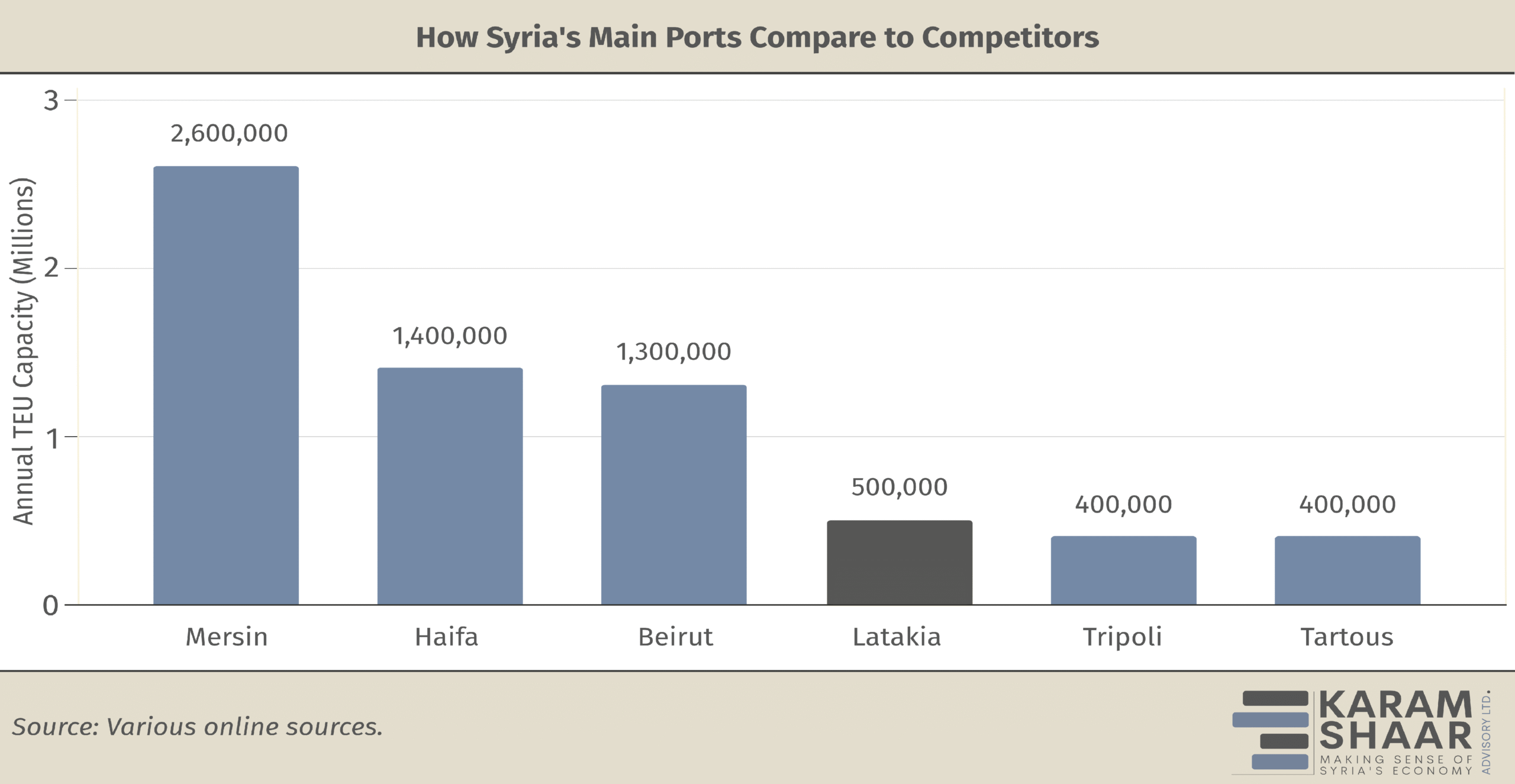
Nevertheless, Latakia will operate in a competitive regional environment. Mersin, Türkiye, has an annual container-handling capacity of 2.6 million TEUs (1 TEU = one 20-foot equivalent unit); Haifa, Israel, handles more than 1.4 million TEUs annually. Beirut and Tripoli, which have historically served the Syrian hinterland given their greater proximity to Damascus and central Syria, respectively, also remain established alternative gateways that both Latakia and Tartous will have to compete with.
Latakia will also face competition from within Syria: DP World is quickly implementing a 30-year, USD 800 million concession to modernize Tartous, where the first new mobile harbor crane arrived in June 2026 as part of a program intended to expand cargo-handling capacity and improve port efficiency.
CMA CGM’s expansion therefore strengthens Latakia’s position, but it does not by itself make the port competitive. Much will depend on whether Syria can improve customs procedures, inland transport, access to banking, insurance coverage, and security conditions. Latakia will therefore need to compete not simply through additional capacity, but through lower costs, faster clearance, predictable customs procedures, reliable inland transport, and regular shipping connections.