
By: Mohamad Ahmad
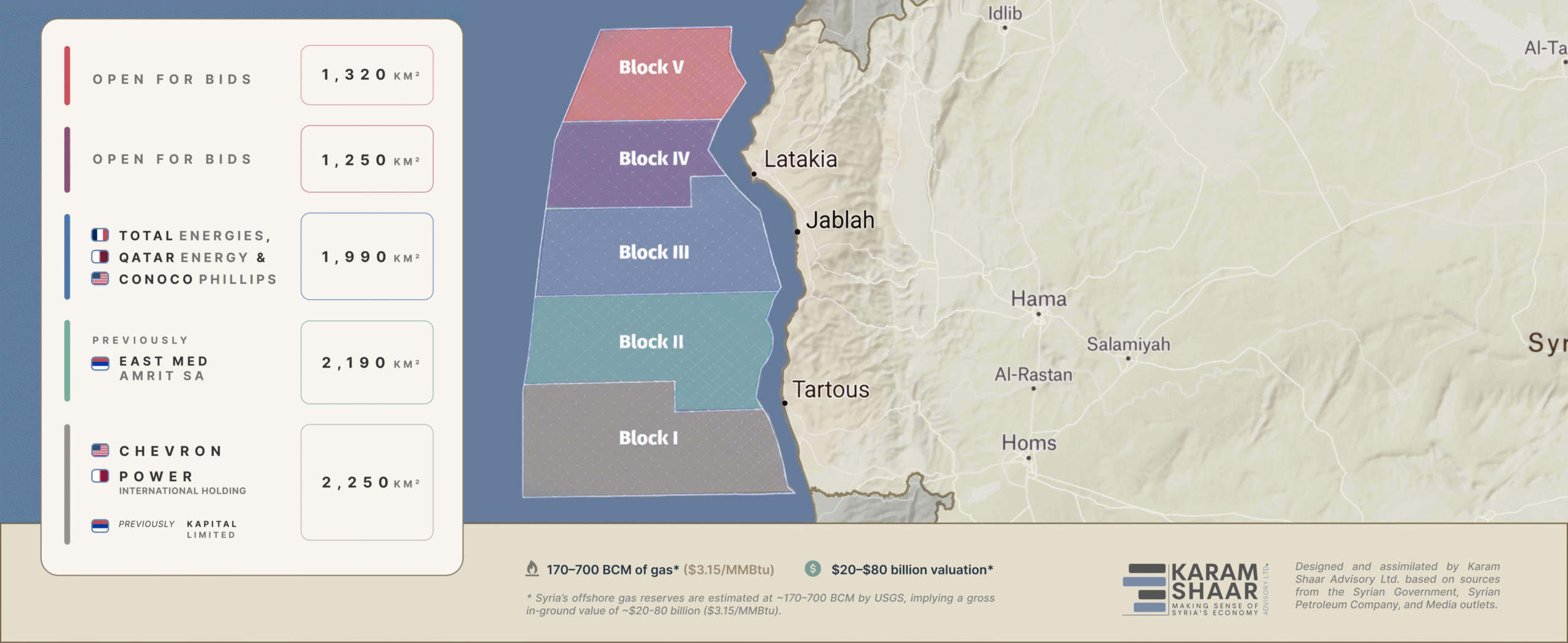
Syria’s five offshore blocks cover approximately 9,000 km² in the northern Levantine Basin (pending delineation of maritime borders). Interest in the potentially lucrative area began nearly two decades ago. Two competitive bid rounds, in 2007 and 2011, produced no awards. Between 2013 and 2021, Blocks I and II were awarded to Russian operators: Kapital LLC and East Med Amrit SA (initially awarded to Soyuzneftegaz in 2013, which then withdrew in 2015). Neither produced a well. Damascus has now moved to close that chapter.
Major investors have recently expressed interest in offshore exploration. Two MoUs were signed with the Syrian Petroleum Company (SPC). One included France’s TotalEnergies, QatarEnergy, and US ConocoPhillips, which outlined exploration plans for Block III off the Latakia coast. The other was signed with US Chevron and Qatar-based Power International Holding.
On 24 June, five months after an MoU was signed, SPC announced that Chevron had been assigned Block I. This effectively terminates Russia’s Kapital LLC contract in the block. The same will likely apply to East Med Amrit SA’s contract in Block II. Reassigning blocks previously held by Russian companies effectively ends Russia’s upstream offshore presence in Syria, leaving the Levantine Basin to operators from Western and regional states.
Some newcomers to Syria’s blocks are already key players in the Basin. Chevron is present in Cyprus and Israel, while TotalEnergies and QatarEnergy hold consortium positions in both Cyprus and Lebanon.
With Russian contracts out of the way, the focus shifts to the basics of governance. Turning MoUs into agreements will require far more than resource potential and investor appetite. Recent high‑level energy talks with the US underscore that political space now exists for Western investment. Whether that interest translates into drilling rigs will depend not only on sanctions and broader geopolitics, but also on Syria’s ability to offer the institutional stability, clarity, and professionalism that deep-water exploration requires.