
By: Abeer Asaad
Over the past decade, the business model of Syrian private banks has undergone a profound transformation. These banks have become mere fund repositories, rather than performing their core role as financial intermediaries that mobilize savings and finance productive sectors.
Our analysis of the annual financial statements published on the Damascus Securities Exchange shows assets concentrated in highly liquid, low-risk categories: cash and balances with the Central Bank and balances and deposits with other banks. At the end of 2024, these accounted for 82% of Islamic banks’ assets and 80% of conventional banks’ assets. This was reflected in liquidity ratios far above the legal minimum of 30% across all currencies.
This excess liquidity has long remained idle while the economy faces a cumulative structural funding gap. Liquidity peaked at 468% in 2016, versus 305% in 2024 at Qatar National Bank-Syria.
This trajectory was further constrained by regulatory restrictions on credit expansion. Lending was suspended in June 2020, followed by a series of controls that capped credit facilities or limited projects eligible for financing, most recently Decision 204 of 2023. In response to increased risks, some banks adopted stricter credit policies, requiring real estate collateral and shorter loan terms. The result was higher liquidity ratios and less credit extended.
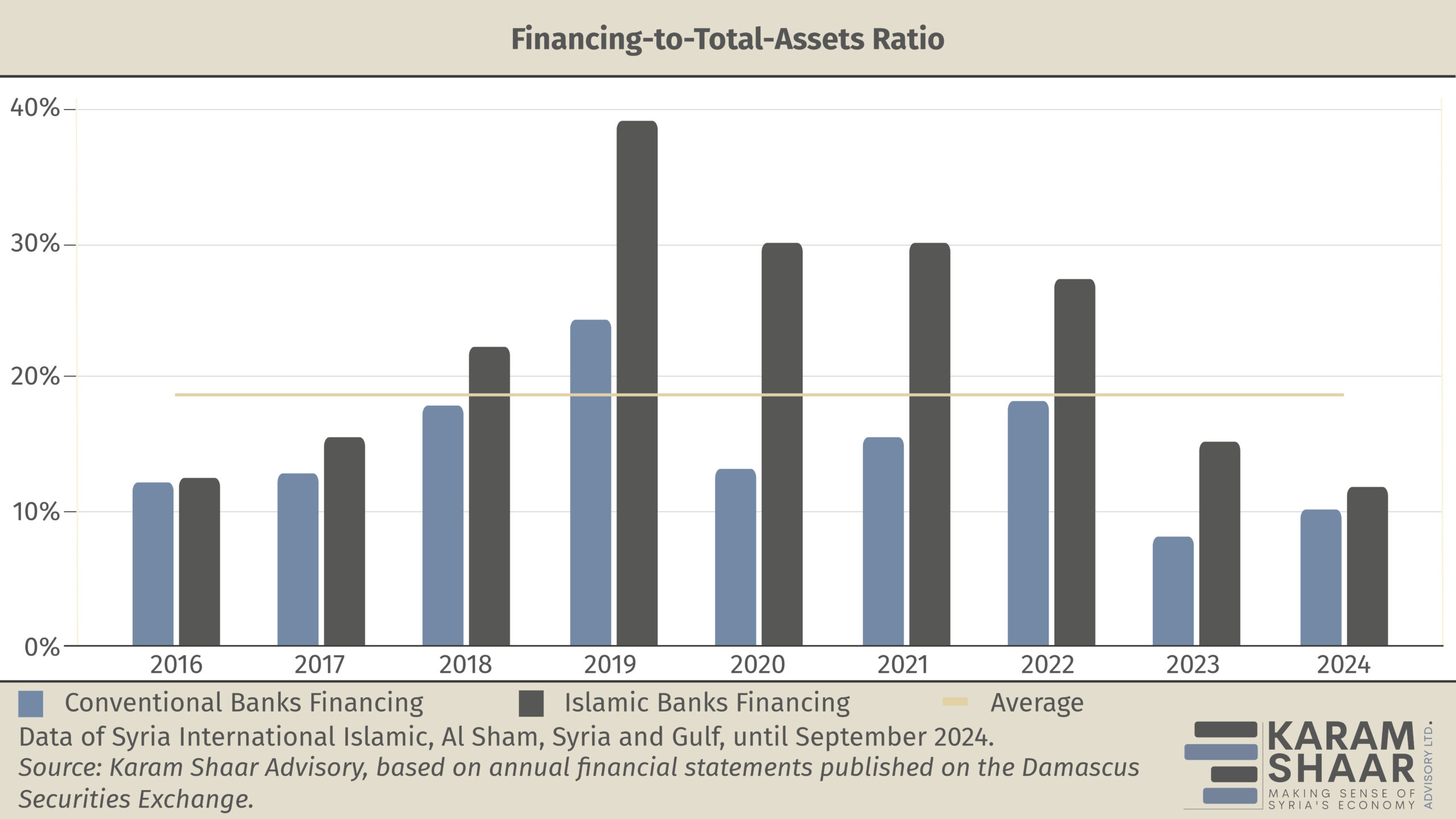
The financing-to-total-assets ratio averaged 19% during 2016–2024, according to our analysis of banks’ financial data. It measures the share of assets used for financing. Its low level reflects limited credit deployment and banks’ tendency to retain liquidity or invest elsewhere. The ratio peaked in 2019 at 39.3% for Islamic banks and 24.5% for conventional banks, while Syria International Islamic Bank recorded the highest individual ratio, at 50%.
The ratio subsequently fell to 10% for conventional banks and 12% for Islamic banks in 2024. These ratios are very low compared with the 55% share of credit facilities in the Arab banking sector that year.
Addressing idle surplus liquidity requires supervisory and regulatory authorities to review monetary policy and credit controls, particularly Decision 204, to channel financing toward small and medium agricultural and industrial enterprises as pillars of economic recovery. This should be accompanied by an independent takaful fund for credit-risk sharing, managed under a wakala investment model and the donation principle (tabarru), while strengthening the Loan Risk Guarantee Corporation to expand guarantee instruments and cover lending risks more flexibly.