By: Abeer Asaad
Syrian banks are reporting sharp increases in profits, yet questions persist about earnings quality and sustainability. Profitability is one of the five core areas covered by the International Monetary Fund’s Financial Soundness Indicators and one of the six components of the CAMELS supervisory rating system. It reflects a bank’s ability to generate net profits through efficient management of its assets and resources, measured by return on assets (ROA), and to deliver an adequate return to shareholders, measured by return on equity (ROE). Recently, however, Syrian banks’ profits have been driven by the collapse of the national currency rather than operational efficiency.
Our analysis of the published annual financial statements of Syrian private banks listed on the Damascus Securities Exchange for 2016–2024, based on calculated ROA and ROE ratios, reveals sharp increases and substantial volatility. ROA peaked at 31% in 2023 before falling sharply to 3% at the end of 2024. Nevertheless, it remained above the Arab banking sector’s ROA of 1.35% in 2023 and 1.43% in 2024. ROE reached a record high of 121.6% in 2023—approximately ten times the Arab banking sector’s 12.7% that year—before plunging to 11.26% by the end of 2024.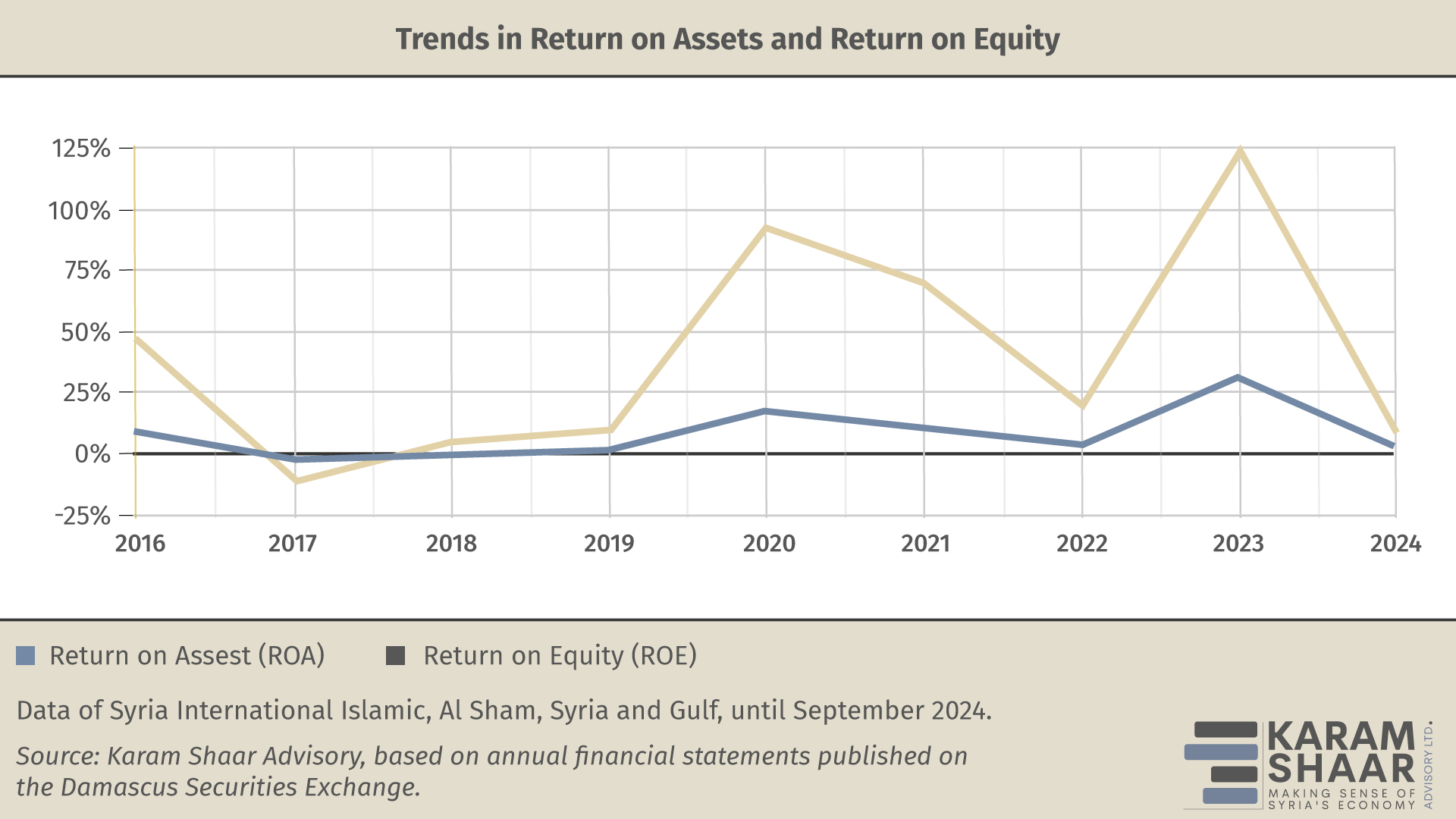
These indicators reveal a paradox: these banks are profitable despite their limited contribution to credit provision, and in some years their returns on assets and equity exceed those of the Arab banking sector.
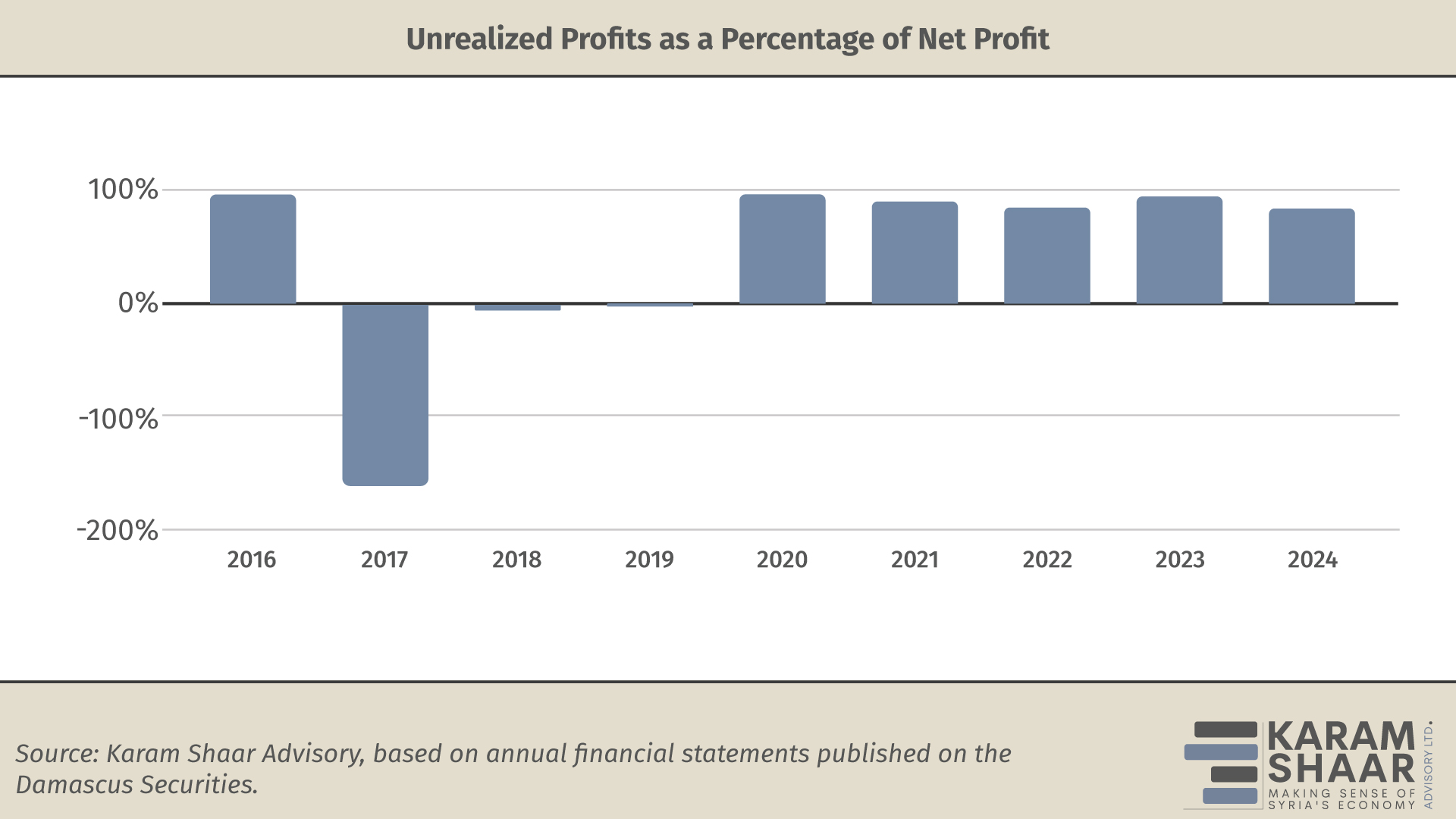
This calls for a careful examination of the source and sustainability of the profits, revealing that the apparent rise in these indicators does not reflect operational efficiency in deploying assets or investing shareholders’ funds. Rather, much of the increase results from the decline of the Syrian pound (SYP) and sharp exchange rate fluctuations during the study period. Unrealized profits accounted for no less than 85% of the banks’ total profits in periods that saw the SYP’s exchange rate collapse against the US dollar (USD). The share of unrealized profits peaked at 96.7% at the end of 2023, when the USD exchange rate against the SYP rose from 3,015 to 12,562.
Consequently, the growing share of unrealized profits in these banks’ earnings makes their financial performance hostage to factors beyond the control of bank management. A fall in the dollar’s exchange rate against the Syrian pound would reduce these profits or turn them into losses, as happened in 2017, 2018, and 2019. The continued dependence of bank profits on exchange rate fluctuations, rather than operational performance, delays banking recovery and weakens the banks’ ability to absorb shocks and withstand pressure.