Syria faces an imminent risk of food shortages as it grapples with one of the most severe droughts in recent years. According to satellite imagery, the 2024–2025 agricultural season (planting to harvest spans October–July) marks a stark deterioration compared to previous years, with exceptionally low rainfall, poor vegetation health, and failing crop performance. The outlook is grim: even improved rainfall in the rest of May will not be enough to compensate for the season’s early deficits.
2025 Drought in Figures
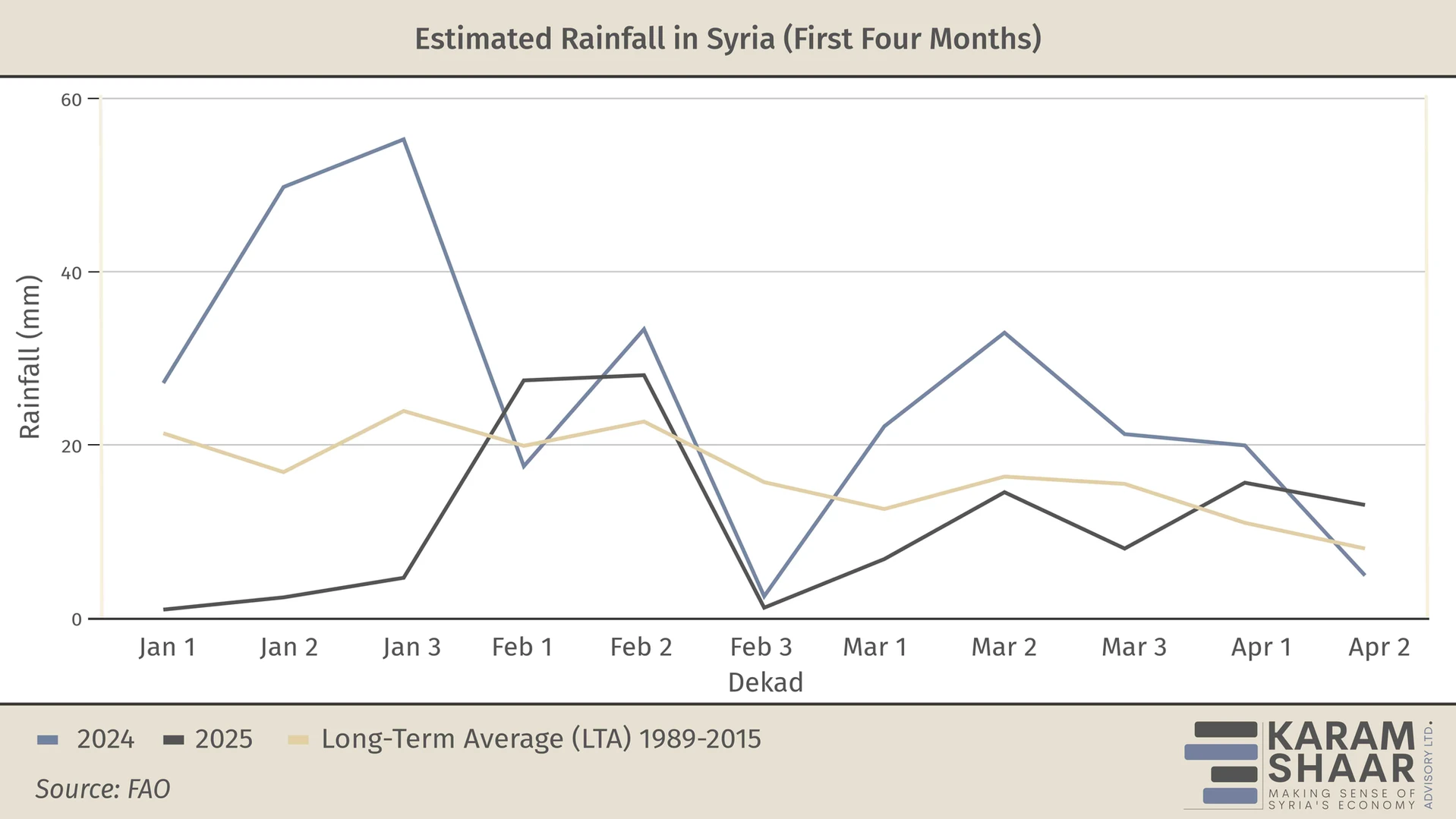
According to the UN Food and Agriculture Organization (FAO), cumulative rainfall during the first quarter of 2025 totaled just 94.9 millimeters (mm)—the lowest level since 1997, the earliest year for which FAO data is available. This is well below the long-term average (1989–2015) of 165.4 mm for the same period and far below the 2019–2024 range of 192.8–298.1 mm in the year’s first trimester. A “dekad” in the charts below refers to a 10-day period for agricultural and meteorological reporting.
While rainfall briefly recovered, peaking at 28–30 mm during the first two dekads of February, it declined again just as quickly, offering only a short-lived boost to vegetation.
The Vegetation Health Index (VHI), which illustrates the severity of drought based on the vegetation health, rose slightly in late February but dropped sharply in March, bottoming out mid-month.
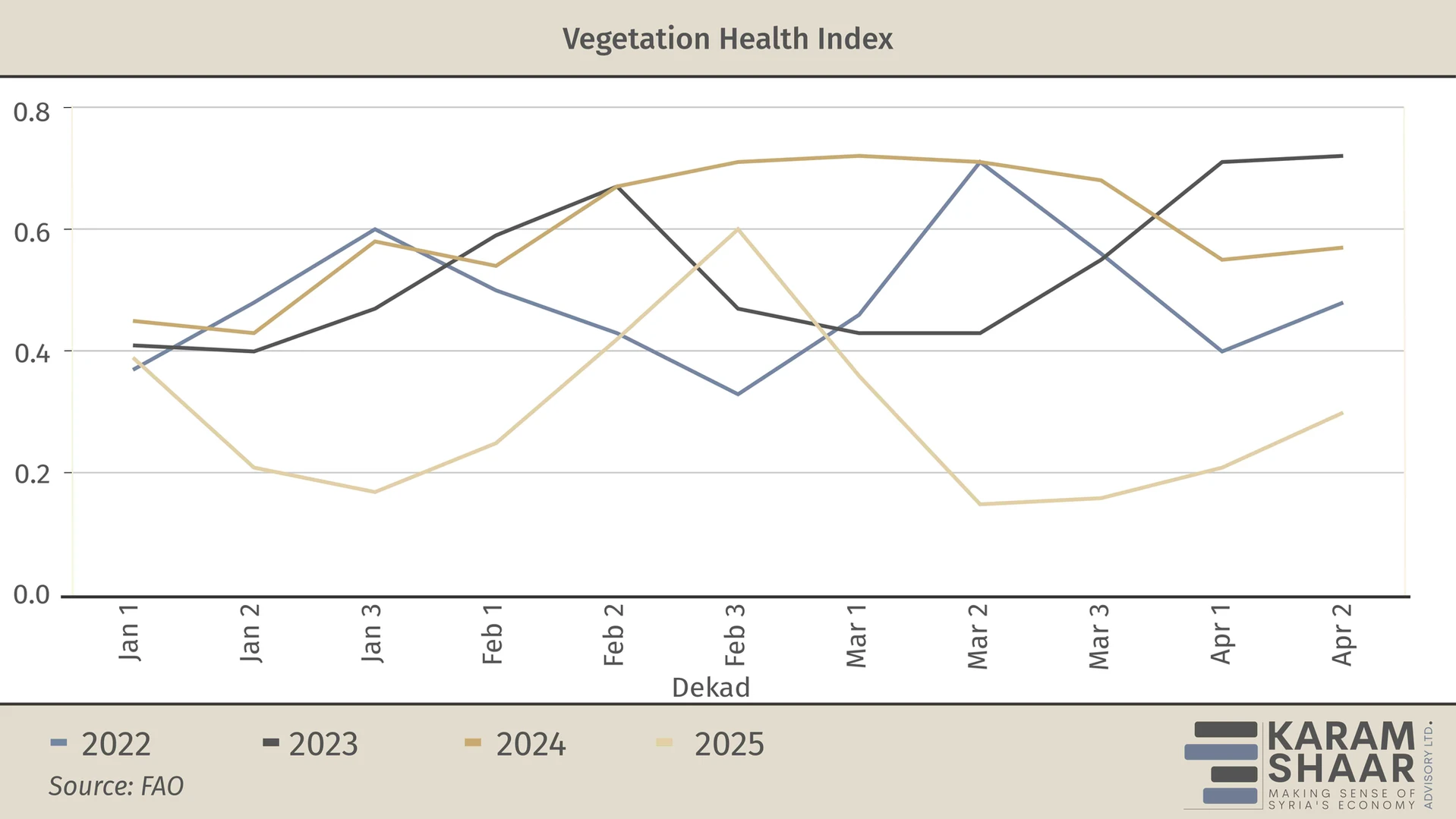
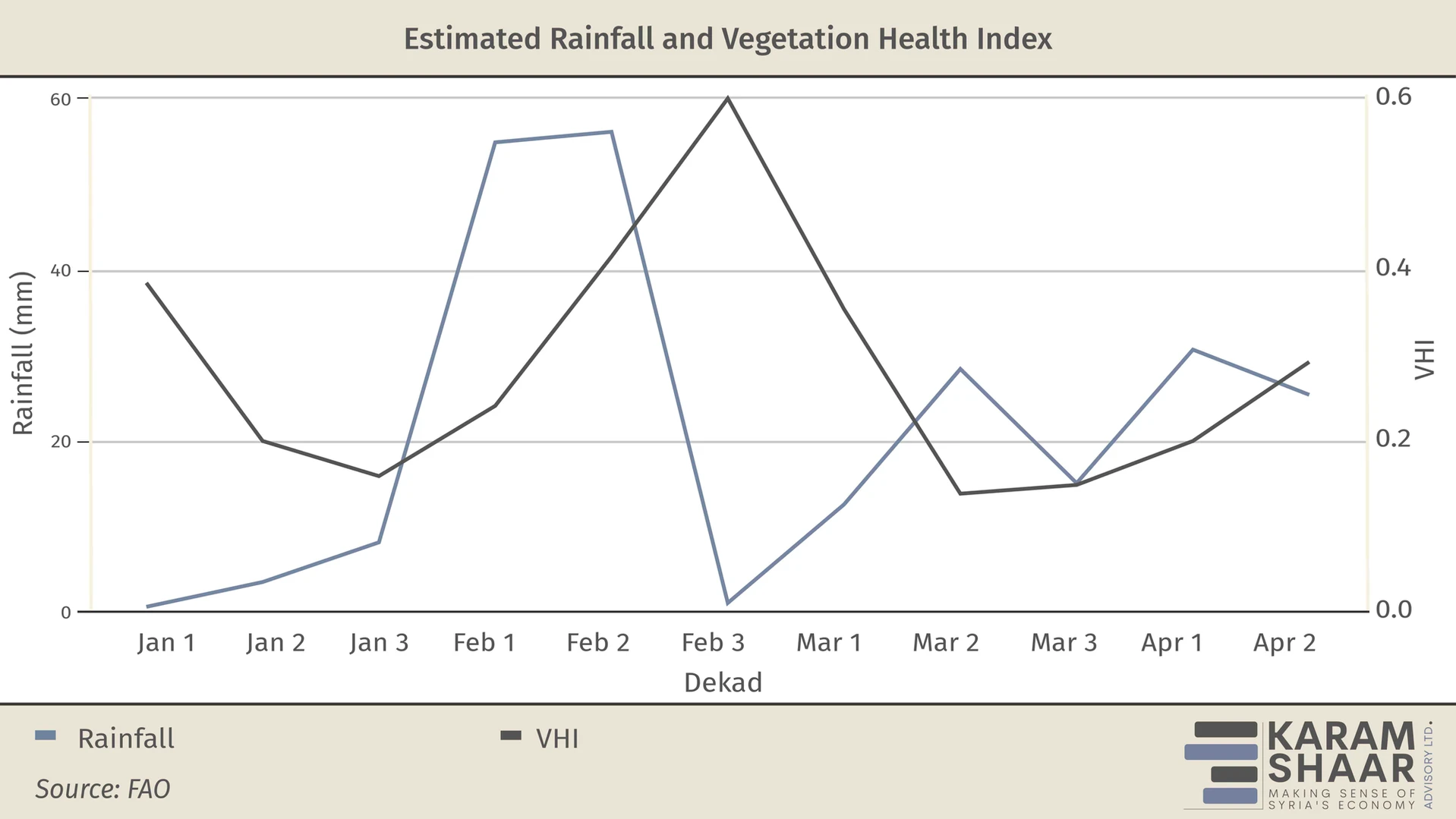
VHI readings for February and March 2025 are 40 to 50% lower than the typical range in previous years. The worst-hit areas include rainfed agricultural zones in Aleppo and Idlib, but the drought has affected nearly all regions, from Hasakah in the northeast to Daraa in the south. In Aleppo, agricultural engineer Yaman Jabbour, interviewed by Karam Shaar Advisory, reported that some fields received no measurable rain at all during February and March, leaving wheat crops completely barren. Despite some moderate rainfall in early April, harvest forecasts remain well below average. Both the World Food Programme (WFP) and the EU’s Copernicus Programme (responsible for earth observation and monitoring) anticipate that cereal crops will not recover this season, despite improved rainfall in April.
The growing season for wheat and barley—Syria’s staple crops—typically spans January to June. To make matters worse, the October–December planting season was already delayed in some parts of the country this year due to the rebel offensive in late November and early December.
Agricultural Stress Index for the Last Dekad of April (2024 left vs. 2025 right)
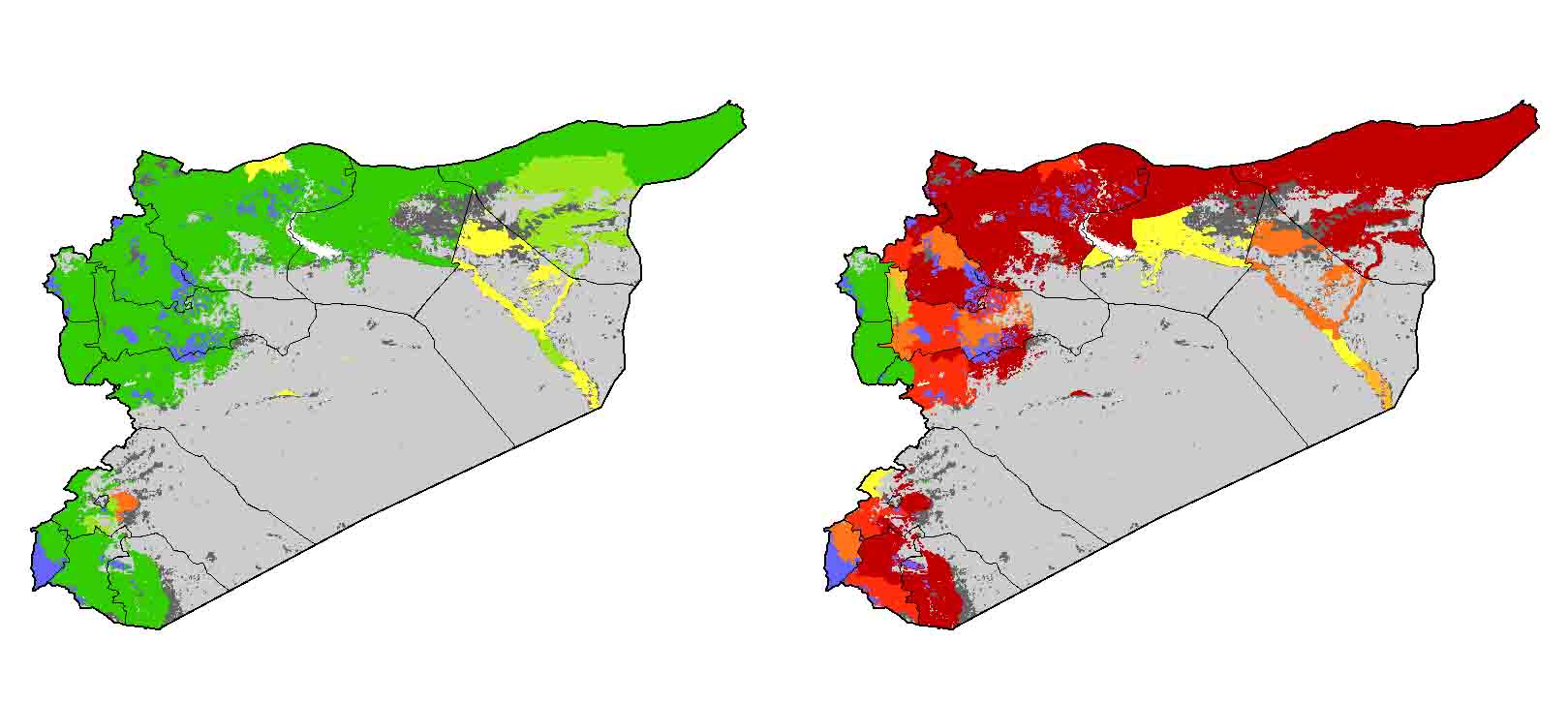
Note: Percentage of cropland area affected by severe drought. Colors range from light green (<10%) to dark red (≥85%) to indicate severity. Additional categories include off-season (blue), no data (black), no seasons (dark gray), and no cropland (light gray).
Source: FAO
Far-Reaching Consequences
The implications of the ongoing drought are profound, threatening Syria’s fragile food security, rural livelihoods, and overall economic stability. Already weakened by more than a decade of conflict, the agricultural sector is ill-equipped to absorb such shocks. The collapse of rainfed agriculture—on which the majority of farmers depend (78% of cultivated land in 2022 was irrigated, according to the Central Bureau of Statistics)—is expected to deepen hunger and malnutrition across a country where millions are already vulnerable.
Reliance on irrigated crops offers little reprieve. Much of Syria’s irrigated farmland lies along the Euphrates River, where water levels have become increasingly erratic. This volatility is driven by irrigation and water infrastructure damage—particularly in the northeast—and compounded by Türkiye retaining more water upstream, leading to decreased water levels in the Euphrates. As a result, some areas that previously cultivated irrigated crops—such as cotton, vegetables, and cereals—now depend on rainfall due to damaged irrigation systems and reduced river flow.
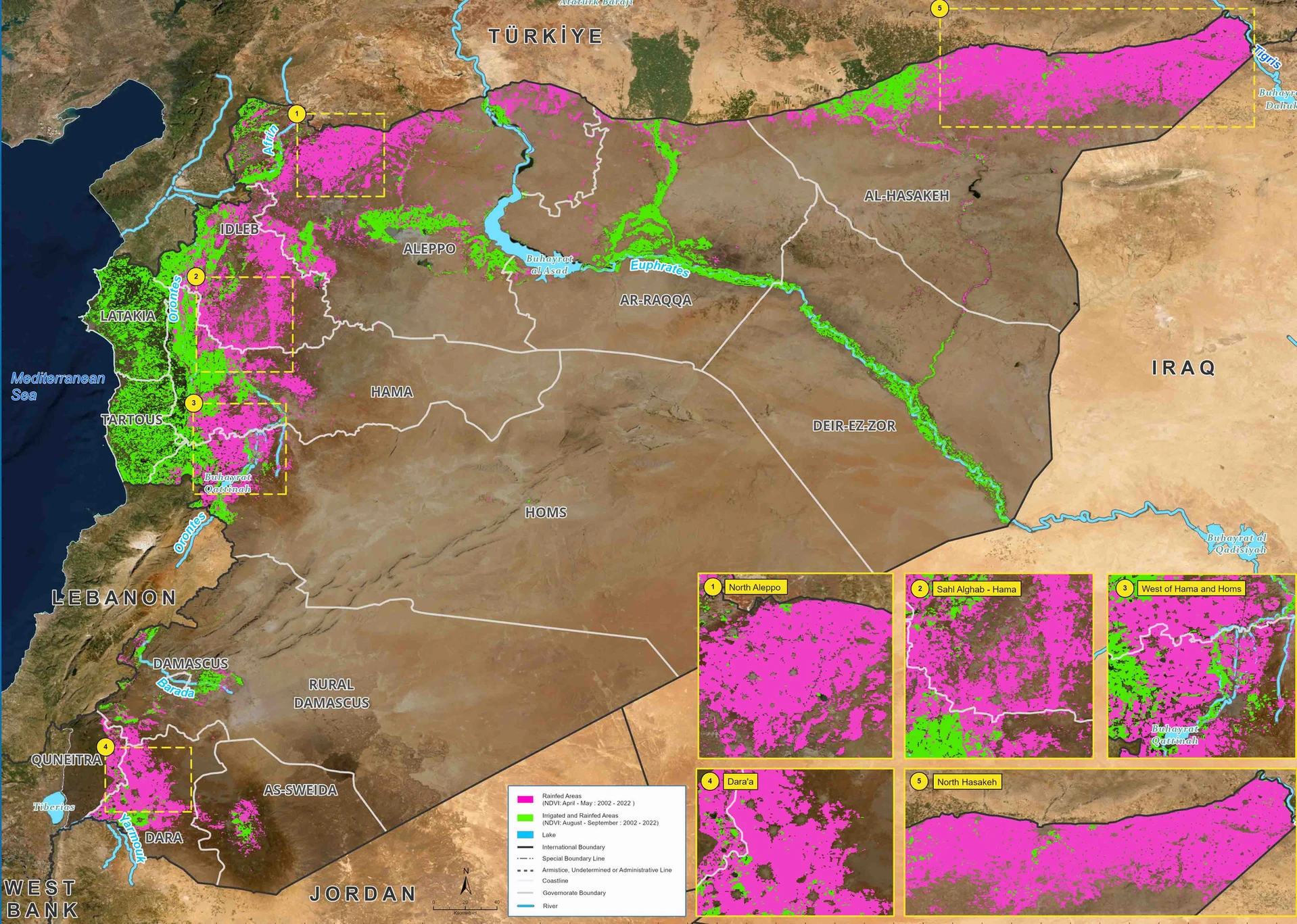
According to Syria’s Central Bureau of Statistics, as of 2022, 74% of cultivated land (2.78 million hectares) was rainfed, compared to only 26% under irrigation—highlighting the country’s vulnerability to rainfall deficits.
Syria’s Irrigated (Green) and Rainfed (Pink) Areas, October 2022
Source: WFP
This year’s harvest is likely to be much lower than last year’s, according to the data presented here and local sources. Yet just as agricultural production is collapsing, humanitarian aid is also in retreat. Funding cuts have forced the WFP to reduce the number of Syrians it assists, despite rising needs. FAO estimates for 2024 show wheat and barley production have already declined by 16.1% and 10.3% respectively compared to the previous year.
Syria will need to import 2.5 million tonnes of cereals to bridge the shortfall. But with depleted foreign exchange reserves and declining humanitarian assistance, the government will have to rely on foreign aid. In mid-April 2025, Syria received its first wheat shipment since the fall of the Assad regime—6,600 tonnes reportedly from Russia—followed by a reported 220,000-tonne wheat shipment from Iraq. Before the regime’s collapse, Damascus regularly imported 1.2 to 1.5 million tonnes of wheat annually from Russia.
The consequences of the drought extend well beyond agriculture, posing serious risks to human security through reduced access to drinking water and heightened public health threats. In mid-April 2025, Ahmad Darwish, Director General of the General Establishment for Drinking Water and Sanitation in Damascus and Rural Damascus, warned that ongoing shortages of rainfall and water resources would lead to increased rationing in both governorates. The agency has already launched public awareness campaigns urging residents to conserve water. And the problem is not confined to Damascus; other urban centers also face reduced access to potable water.
Health risks are likewise mounting. Droughts increase cholera risk by limiting water availability and forcing communities to adopt unsafe practices, such as drinking untreated water or reusing water sources. Following Syria’s last major drought in 2020–2021, the country experienced its first cholera outbreak since 2008–2009. The outbreak began in the northwest but eventually affected all governorates, causing 106 deaths, according to the UN’s Cholera Outbreak Situation Report from November 2023. With current drought indicators worse than those recorded in 2020–2021, the risk of another outbreak—particularly if mismanaged—remains high.
Despite the severity of the crisis, both the Syrian caretaker government and the new interim government have taken little to no meaningful steps. Aside from rain prayers organized by the Caretaker Ministry of Endowments in January 2025, no concrete policy measures have been enacted.