Since Assad’s downfall in December 2024, Syria’s transitional authorities have intensified anti-corruption enforcement and reorganized the country’s oversight institutions. New settlement mechanisms, expanded inspections, and pledges of financial reform signal a shift in supervisory activity. Yet these developments have unfolded within a consolidated executive structure, raising questions about whether oversight reform is aimed at strengthening accountability or concentrating it within the Presidency.
Executive Reorganization
In the first half of 2025, Syria’s Central Authority for Supervision and Inspection (CASI) stated in media remarks that approximately 1,400 corruption cases had been registered, primarily involving financial misconduct and procurement fraud. According to a media interview, confirmed violations were estimated at around 350 billion SYP (approximately USD 30 million at 11,650 SYP/USD). Nearly 200 cases were referred to the judiciary, with between 1,350 and 1,400 individuals transferred to the competent courts.
At the same time, CASI has also increased the visibility of its inspection activity, publishing statistical infographics detailing investigations, financial recoveries, and case referrals.
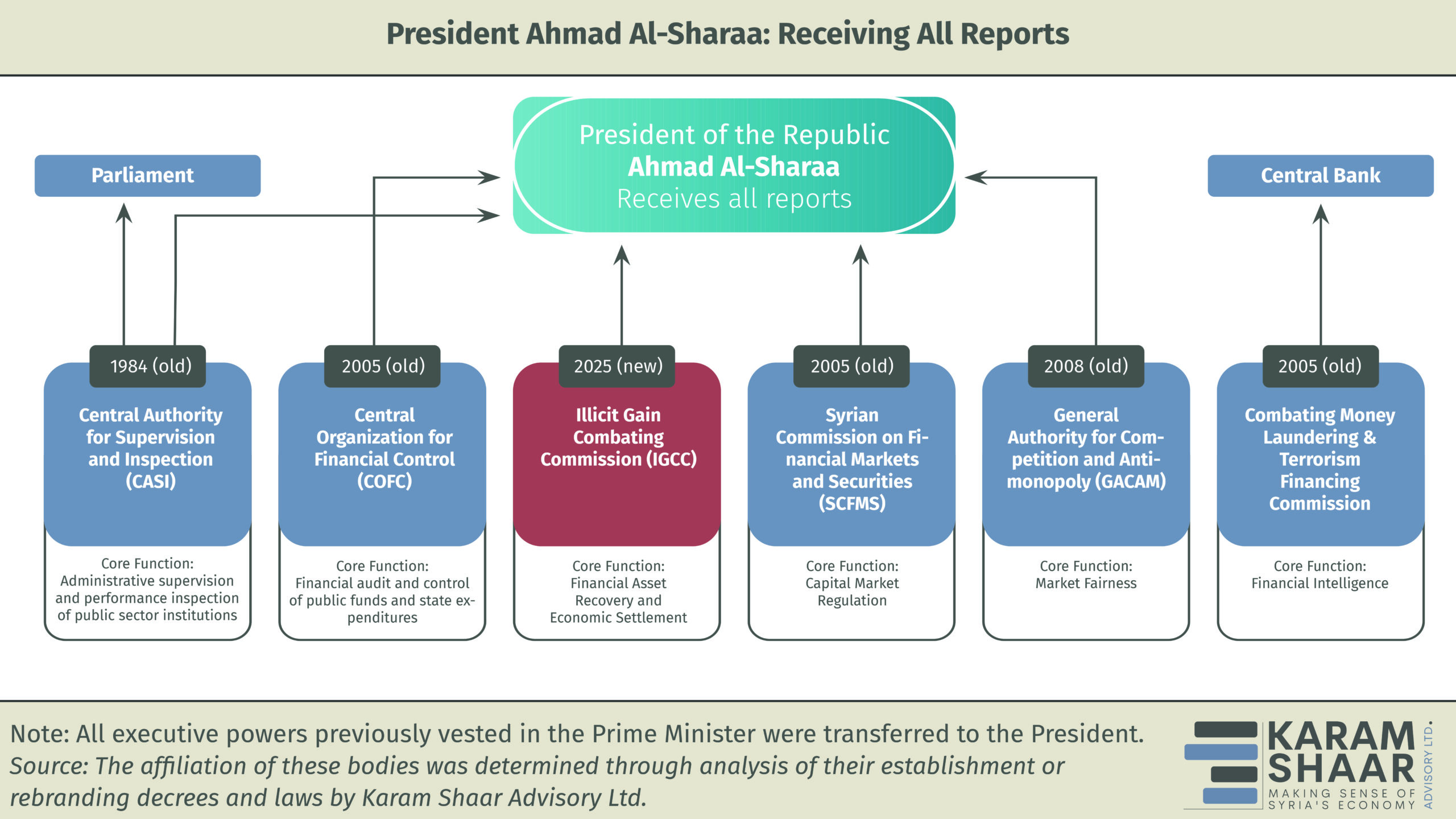
This intensification of enforcement coincides with a broader restructuring of Syria’s oversight architecture. In March 2025, the transitional government was formed without a prime minister, consolidating executive authority under the Presidency through the Presidential Secretariat, headed by al-Sharaa’s brother. As a result, most oversight bodies now report directly to the President rather than through an intermediary executive tier.
Formally, the restructuring was presented as an effort to enhance efficiency and address bureaucratic fragmentation through ministerial mergers. However, the concentration of reporting lines under the Presidency reduces institutional distance between supervisory bodies and executive authority, potentially reshaping the balance between oversight and executive control.
The current expansion of oversight activity should therefore be viewed not only as an attempt to address legacy corruption, but also as part of a broader administrative consolidation. Whether enforcement mechanisms will extend to misconduct involving newly empowered authorities remains uncertain.
Central Organization for Financial Control Expands Its Operations
The scope of the Central Organization for Financial Control’s (COFC) activity has also expanded markedly, suggesting a substantial intensification of audit activity and enforcement exposure. In 2023, the latest year for which there are publicly available reports, the organization claimed financial violations amounting to SYP 95 billion (approximately USD 6.7 million at 14,200 SYP/USD).
More recent statistics suggest a substantial escalation. According to official figures published since Assad’s downfall, the total volume of financial corruption uncovered amounted to about SYP 527 billion (approximately USD 45.2 million at 11,650 SYP/USD), among other cases.
The Organization’s mandate includes auditing public accounts, monitoring financial and administrative compliance across ministries and state-owned entities, and safeguarding public funds. Over the past year, it has expanded its digital footprint through its official website and by activating a public reporting platform, enabling online submission of complaints and publication of oversight outcomes. These steps reflect an effort to formalize reporting mechanisms and broaden supervisory reach.
The organization is currently headed by Mohammad Omar Qdeid, also known as Abu Abdelrahman, who was previously affiliated with Jabhat al-Nusra and later Hayat Tahrir al-Sham. Because the COFC reports exclusively to the Presidency, it is structurally centralized within the executive apex.
Illicit Gain Combating Committee and Open Questions
The activities of the Illicit Gain Combating Committee (IGCC) appear more consequential in scale than those reported by CASI and the COFC. According to media reporting, more than 900 individuals are currently under pursuit, and assets reportedly valued at around USD 800 million were recovered in a single settlement with an Assad-era businessman. These figures exceed the financial exposures typically documented by other oversight bodies.
The IGCC, established by Presidential Decree 13 of 2025, has positioned itself at the center of efforts to address illicit enrichment linked to the former regime. On its official site, the Committee outlines a six-month Voluntary Disclosure Program, scheduled to conclude at the end of May 2026, allowing individuals and entities suspected of illicit gain to normalize their financial status through negotiated settlements. The Committee presents this mechanism as a means of accelerating asset recovery in light of judicial constraints and the protracted timelines associated with formal litigation.
Following public protests and media criticism concerning transparency, the Committee has clarified that settlements do not extinguish public rights or exempt participants from criminal liability, nor do they affect victims’ personal legal claims. In official statements, it has emphasized that asset recovery proceeds in parallel with other justice mechanisms and does not replace criminal accountability.
At the same time, a legal ambiguity remains. Article 4 of the decree defines the Committee’s jurisdiction as covering holders of public office and civilian and military employees. In practice, however, enforcement has thus far focused on private-sector business figures associated with the former regime. This divergence between formal jurisdiction and operational targeting raises questions about the Committee’s interpretive scope and legal anchoring.
The central issue may therefore lie less in the concept of voluntary settlements itself than in the transparency of their negotiation: the valuation of assets, the terms of financial set-off, the destination of recovered funds, and the institutional mechanisms overseeing their redistribution.
An open institutional question persists as to whether the Committee’s mandate will remain confined to the temporary Voluntary Disclosure Program or evolve into a permanent anti-corruption body with clearly articulated procedural safeguards and judicial integration. Its long-term credibility will depend on the degree to which transparency and accountability are embedded within its operations.