
By: Ben Feve
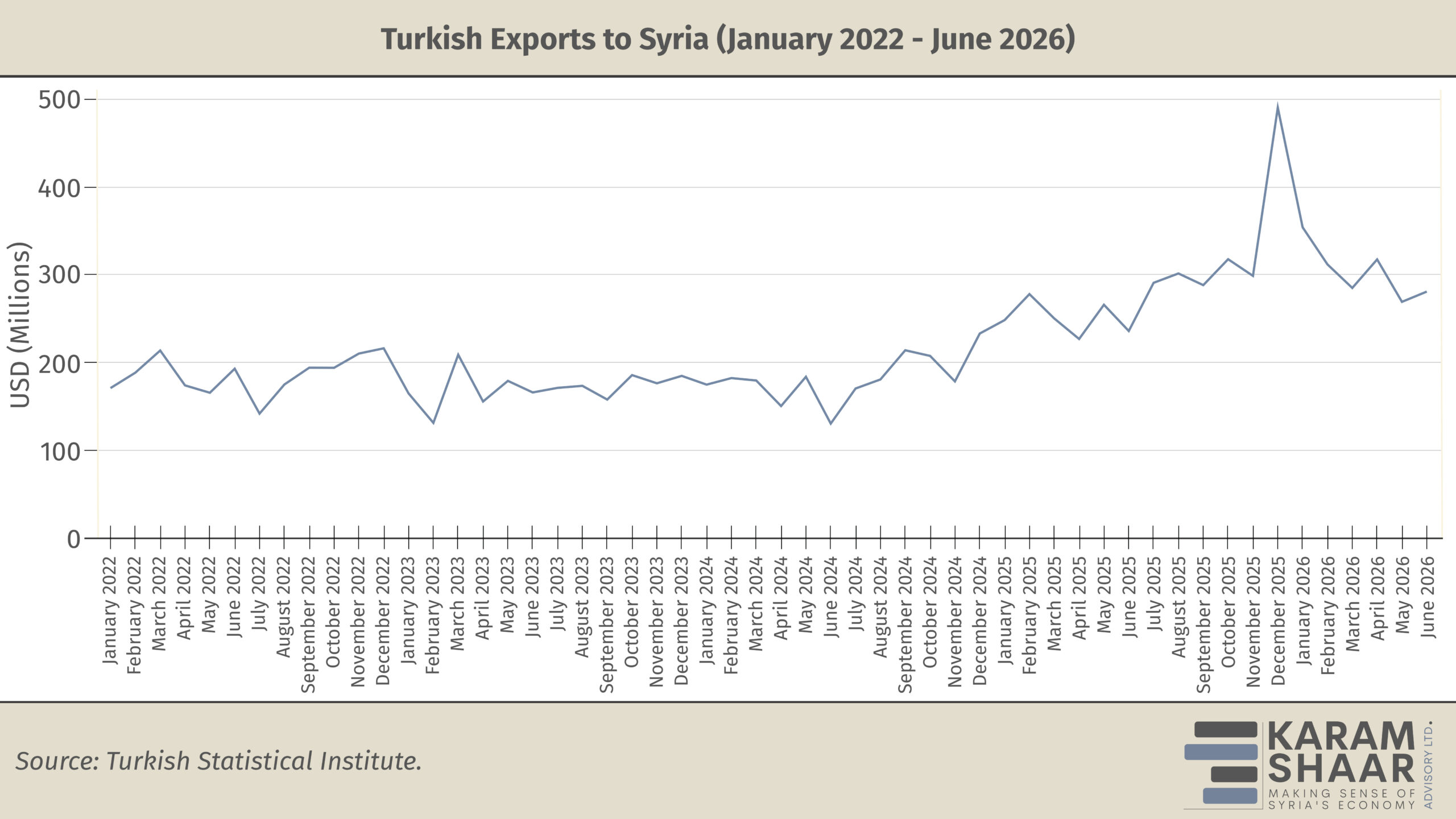
Turkish exports to Syria reached USD 1.8 billion in the first half of 2026, up 21% from the same period of 2025, according to the Turkish Statistical Institute. Read against the first half of last year, the trade relationship continues to deepen. Read sequentially, it has stopped growing: exports in the second half of 2025 were USD 2.0 billion, so the first six months of 2026 came in 8.5% below the preceding half-year.
The monthly path makes the plateau clearer. Exports rose steadily through 2025, from USD 248 million in January to USD 491 million in December, an anomaly that nevertheless represented the single strongest month on record since Assad’s fall. Exports then settled at USD 354 million in January 2026 and decreased to USD 281 million by June. The recent surge appears to have found its level rather than continued upward.
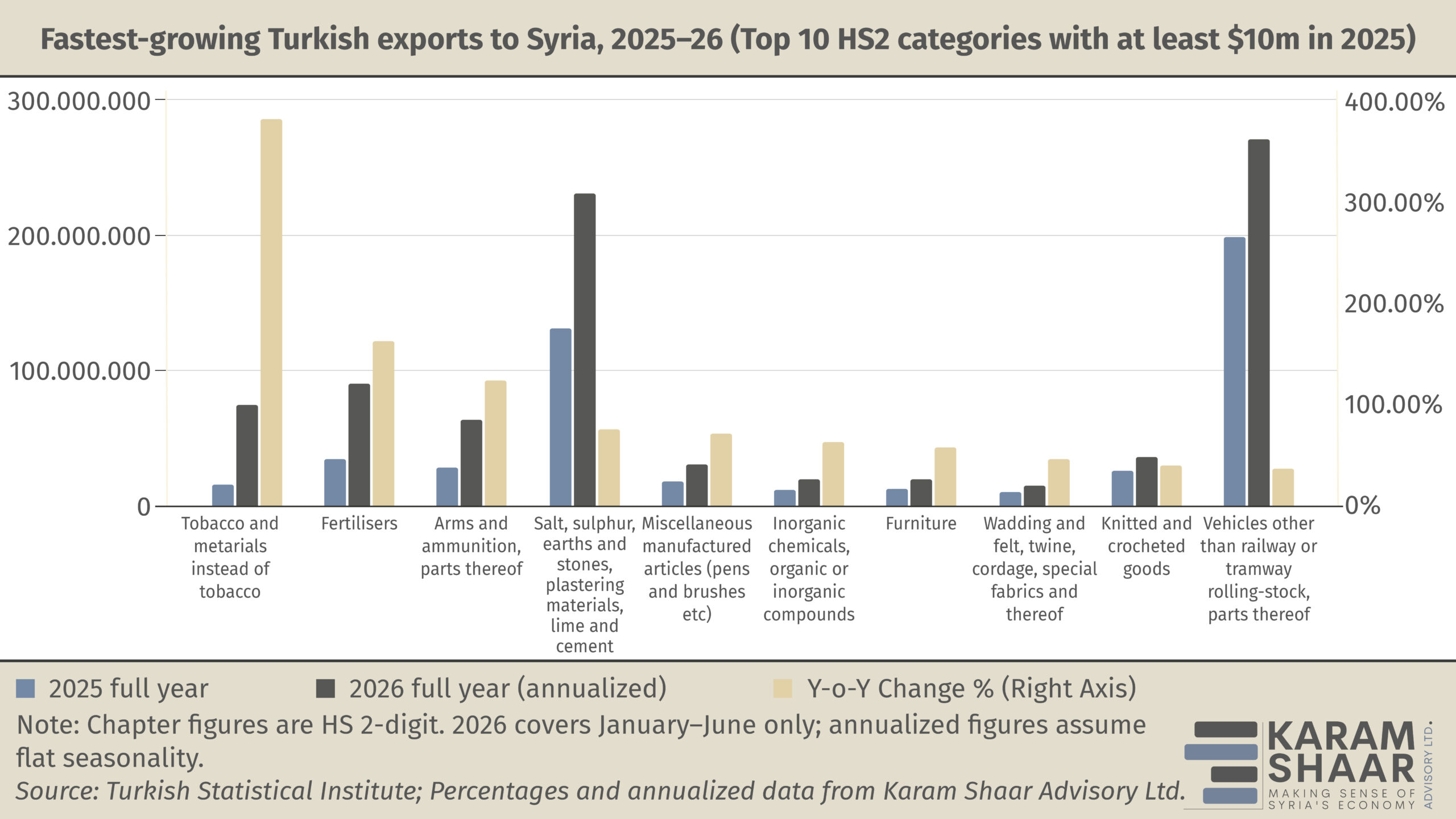
There is a consequential change in what is shipped. Comparing annualized first-half 2026 values with full-year 2025, and restricting the comparison to commodity groups worth at least USD 10 million in 2025, construction and capital goods dominate the gainers. Salt, stone, plaster, lime and cement rose 76%; fertilizers rose 162%; furniture rose 58%; and vehicles and parts, the largest single commodity group after mineral fuels, rose 36%. Tobacco grew fastest, up 381%, and arms and ammunition rose 124%.
The declines were almost entirely in food and consumer goods. Meat and edible offals collapsed 93%, while sugar and confectionery fell 58%, cereal and flour preparations 37%, cereals 33%, and cocoa preparations 35%. Pharmaceutical products dropped by 62%, and ceramics by 49%. Iron and steel, down 37%, is the notable exception in the construction sector.
The thirteen food and agri-processing commodity groups also contracted 9% in aggregate, while construction materials, machinery, metals and vehicles expanded 13%. Turkish suppliers seem to be selling less of what Syrian households eat and more of what rebuilding requires.
Two readings compete. The fall in food imports may reflect Syrian producers recovering ground in flour, sugar, and processed foods after a year of being undercut. It may equally reflect an initial Assad-era pent-up demand that finally dried up.