By: Ben Feve
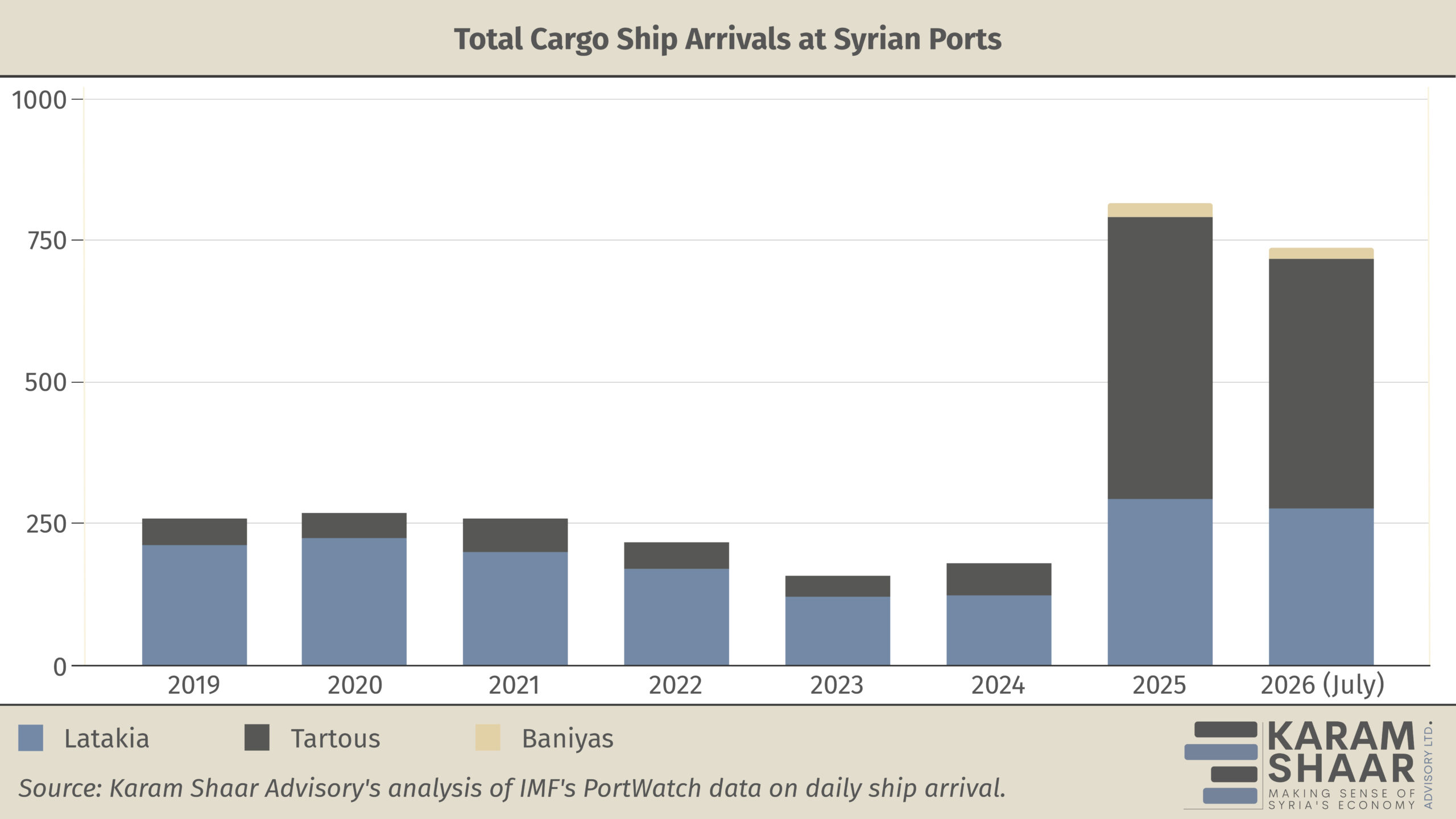
Ship arrivals at Syria’s three main ports jumped from 180 in 2024 to 815 in 2025 and reached 737 by July 2026, according to the IMF’s PortWatch platform, which uses Automatic Identification System (AIS) ship-tracking signals to monitor and estimate global maritime trade.
Tartous received 500 ships last year, up from just 56 in 2024. Close to a ninefold increase, this figure pushed Tartous past Latakia to become Syria’s busiest port by number of arrivals.
Latakia also recovered, more than doubling from 123 to 292 arrivals. This reversed a decline that had continued since 2020, when the port recorded 223 ships, before reaching a low of 120 in 2023, according to PortWatch.
The faster recovery in Tartous port seems to stem from its operational focus. Tartous mainly handles general cargo and dry bulk, serving as the main entry point for grain, food, machinery, and construction materials. These are the basic goods required for survival and early reconstruction. When local demand returns, bulk shipping scales up quickly to meet it.
In contrast, raising Latakia port’s container traffic relies on more than increased demand. It requires rebuilding regular shipping routes, a functioning financial system, predictable customs procedures, and reliable inland roads. And that takes time.
Baniyas port recorded its first activity after years of apparent dormancy. It had no recorded arrivals between 2019 and 2023, followed by only one in 2024. Nonetheless, Iranian tankers likely used the port during that time, albeit under the radar. In 2025, the number rose to 23, and stands at 20 so far in 2026, making it Syria’s smallest port by far. While Baniyas is central to Syria’s oil and gas tanker trade, PortWatch classifies these vessels as general cargo, leaving the exact nature of the shipments unclear.
The upward trend is holding in 2026. With 737 total arrivals through July (275 at Latakia, 442 at Tartous, and 20 at Baniyas), 2026 is poised to significantly surpass 2025 totals.
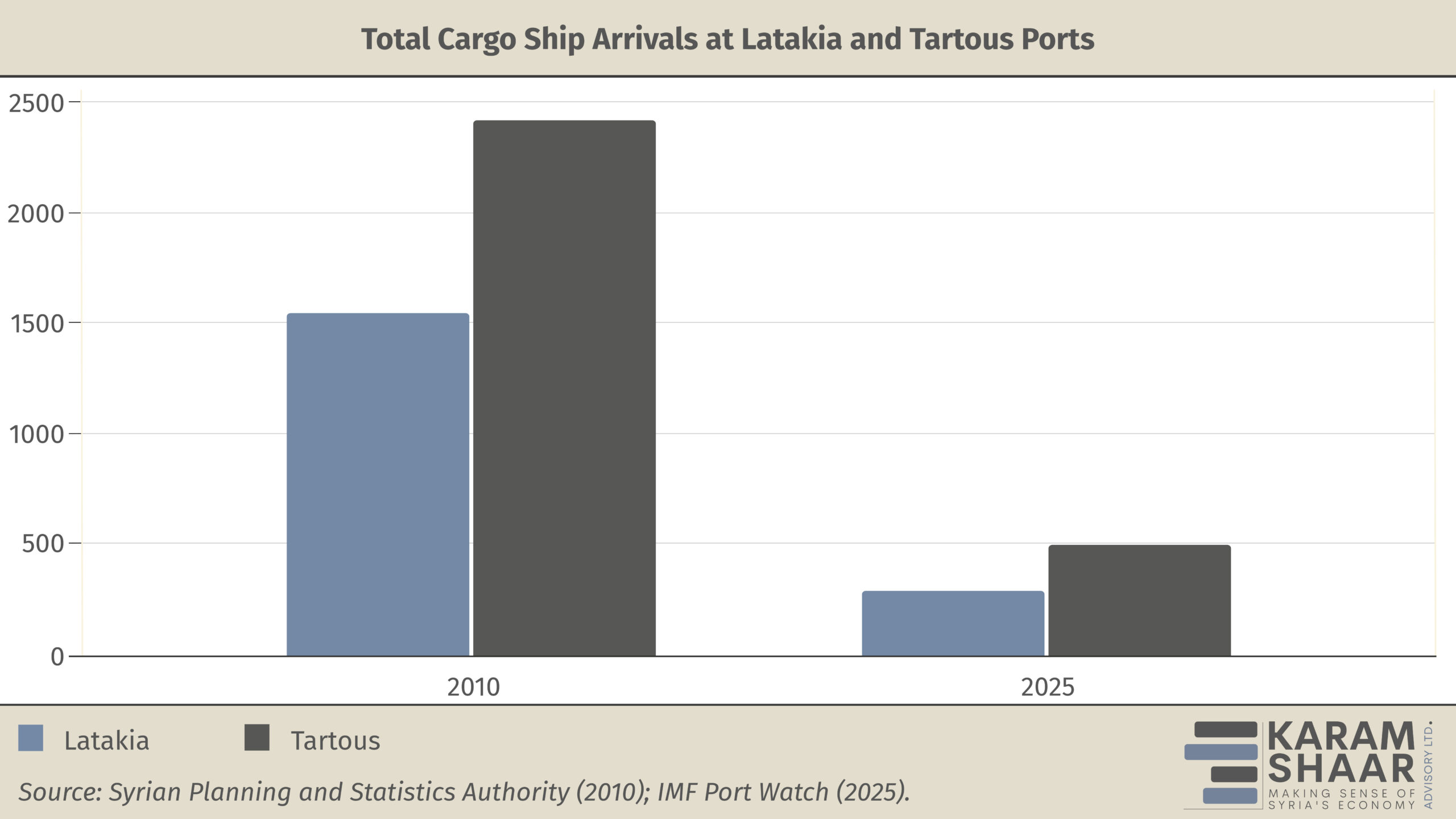
Despite the sharp rebound, activity remains a fraction of pre-war levels. In 2010, Tartous received 2,418 ships and Latakia 1,548. The 2025 totals at both ports were roughly one-fifth their 2010 traffic. Keeping up the pace will require steady strides toward a functioning, globally integrated economy.